The post ON GEORGIA AND CHINA: Strategic Perspectives appeared first on Ng Teng Fong· Sino Group Belt and Road Research Institute.
]]>
ISBN:
978-988-72370-4–4
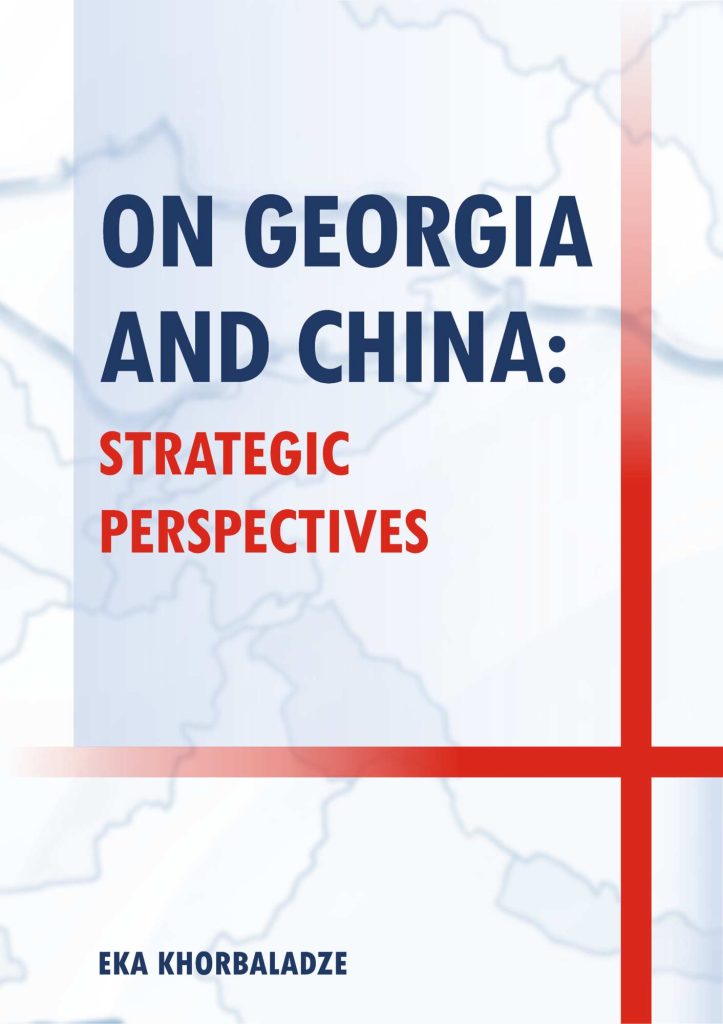
ON GEORGIA AND CHINA: STRATEGIC PERSPECTIVES brings together a body of policy analysis and case study research produced over the course of the author’s engagement with the Ng Teng Fong · Sino Group Belt and Road Research Institute. The collection examines Georgia’s evolving position within the shifting architecture of Eurasian connectivity, at a moment when the Middle Corridor has moved from a secondary alternative to a central artery of China-Europe trade.
The volume is organized in two parts. Part I collects two policy briefs written for a strategic and institutional audience. The first, “Georgia as China’s Strategic Gateway to Europe,” offers a comprehensive assessment of Georgia’s geographic and institutional position following the elevation of China-Georgia relations to a Comprehensive Strategic Partnership on June 9, 2026, and sets out a series of pillars for deeper engagement, spanning corridor logistics, the Anaklia deep sea port, e-commerce infrastructure, digital connectivity, energy and industrial development, and financial cooperation. The second brief, “Unlocking Strategic Connectivity,” addresses a narrower but consequential question: the case for direct air services between Hong Kong and Tbilisi as a practical instrument of closer economic and people-to-people ties.
Part II turns to longer-form articles and case studies. “The Middle Corridor and the Geopolitics of Eurasian Connectivity” situates Georgia within the broader competition among China-Europe trade routes, tracing how disruptions along the Northern Corridor and the Suez route have accelerated the corridor’s growth and reshaped the calculus of the states along it. “Case Study: Georgia’s Anaklia Deep Sea Port” examines the project regarded as the most consequential single piece of infrastructure for Georgia’s role in Black Sea shipping, and the questions of financing, governance, and geopolitical alignment that continue to surround it. The closing piece, “Georgia and the Middle Corridor: Strategic Transit Hub in the Reconfiguration of Eurasian Trade Routes,” draws the preceding analysis together into a broader argument about Georgia’s function as a transit state amid the reordering of Eurasian trade.
Read together, pieces approach Georgia neither as a peripheral actor nor as an abstraction in great-power competition, but as a country whose geography, at the junction of the Black Sea, the Caspian basin, and the routes linking them to European markets, gives it a structural relevance disproportionate to its size.
The essays were written at different points and for different purposes, and some overlap in context and argument is inevitable in a collection of this kind. They are presented here as a coherent record of one line of research into Georgia’s place in the Belt and Road Initiative and in the wider reconfiguration of Eurasian connectivity.
Purpose of the volume: The collection sets out to assess Georgia’s position within the Belt and Road Initiative and the wider reconfiguration of Eurasian connectivity, and to put that assessment into a form usable by policymakers, investors, and institutional audiences. Each piece approaches this aim from a different angle. The two policy briefs in Part I identify concrete pillars for deeper China-Georgia engagement and make the case for direct Hong Kong-Tbilisi air service. The three articles and case studies in Part II examine the Middle Corridor’s institutional development, the Anaklia Deep Sea Port’s contested history and strategic prospects, and Georgia’s function as a transit hub within the reordering of Eurasian trade. Read together, the volume aims to set out, on a verifiable evidence base, why Georgia’s geography gives it a structural relevance to Eurasian trade disproportionate to its size, and where that relevance remains unrealized.
Methods: The research underlying the collection is qualitative and desk-based. It draws on official statistics from national railway and port operators (Georgian Railways, Azerbaijan Railways, Kazakhstan Temir Zholy, and APM Terminals Poti), reporting from multilateral institutions (the World Bank, the OECD, the Asian Development Bank, the Asian Infrastructure Investment Bank, the European Bank for Reconstruction and Development, and the European Union), official Georgian government sources, US Congressional and Helsinki Commission statements, and policy analysis from institutions including the Foreign Policy Research Institute, the Jamestown Foundation, the CACI Analyst, and CSIS. This is supplemented by regional and specialist trade press and by organizations that systematically track Chinese overseas investment, such as the Green Finance & Development Center at Fudan University. Quantitative claims, including cargo volumes, investment figures, port capacities, and financing terms, were cross-verified against at least one primary or institutional source. The case studies build on this base with structured analytical tools: a SWOT analysis and a twelve-risk assessment matrix, scored on a 1-5 likelihood-impact scale consistent with ISO 31000:2018, for the Anaklia port study, and scenario-based forecasting across pessimistic, baseline, and optimistic trajectories for both the Anaklia and the Hong Kong-Tbilisi air service assessments.
Findings: Taken together, studies reach several conclusions. The Middle Corridor has moved from a marginal alternative to a structurally significant component of Eurasian trade, a shift driven in large part by the 2022 disruption of the Northern Corridor and by Red Sea and Strait of Hormuz risk to Suez routing; container volumes along the route grew from 20,500 TEU in 2023 to 57,000 TEU in 2024. Georgia occupies an indispensable position within this architecture, but its own port and rail infrastructure, rather than corridor demand, is currently the binding constraint on how much of that growth it can capture. The Anaklia Deep Sea Port remains the single project on which Georgia’s long-term corridor ambition depends. Its strategic value is not in question, but its realization now turns on the government’s ability to attract credible terminal operators and financing under the state-owned landlord model adopted in July 2026, following the withdrawal of the earlier Chinese-Singaporean consortium arrangement. Direct air service between Hong Kong and Tbilisi is assessed as commercially and strategically viable through a phased market entry, beginning with charter or codeshare service ahead of scheduled operations. None of these findings is offered as a fixed prediction; they describe trajectories that, as of mid-2026, remain subject to political, financial, and regulatory conditions still in motion.
Full Book:
Chapter:
PART I: POLICY BRIEFS
- Georgia as China’s Strategic Gateway to Europe: A Comprehensive Strategic Guide for Engagement in The South Caucasus and Beyond
- Unlocking Strategic Connectivity – The Imperative for Direct Air Services Between Hong Kong (HKG) and Tbilisi
PART II: ARTICLES AND CASE STUDIES
- The Middle Corridor and The Geopolitics of Eurasian Connectivity: China’s Strategic Engagement
- Case Study: Georgia’s Anaklya Deep Sea Port
- Georgia and The Middle Corridor: Strategic Transit Hub in The Reconfiguration of Eurasian Trade Routes
The post ON GEORGIA AND CHINA: Strategic Perspectives appeared first on Ng Teng Fong· Sino Group Belt and Road Research Institute.
]]>The post The Belt and Road Initiative and Economic Development of Azerbaijan appeared first on Ng Teng Fong· Sino Group Belt and Road Research Institute.
]]>
ISBN:
978-988-72370-0-6
It covers a wide range of economic relations between China and Azerbaijan in the context of the Belt and Road Initiative. The book not only provides an analytical examination of the rapidly growing economic ties between the two countries but also presents substantial empirical data and case studies of Chinese companies’ cooperation projects in Azerbaijan. With the revival and expansion of the Middle Corridor of the new Silk Road, China and Azerbaijan have become important strategic partners for regional connectivity and development. The monograph is intended to provide a pioneer venture to lay the groundwork for further research into this important geo-political and geo-economic issue.
The preparation and publication of this monograph were made possible by a donation from Ng Teng Fong Charitable Foundation Limited provided to Hong Kong Chu Hai College.
Full Book:
Chapter:
China’s Industrialization, 1949 – Present:
Thomas Man Hung Chan_China’s Industrialization, 1949 – Present
Author: Thomas Man Hung Chan
DOI: https://doi.org/10.63596/azerb-2026-1
Page Number: 6-27
Diversification and Sophistication of Exports from Azerbaijan to China: THEIL Index and Granger Causality Test*Diversification and Sophistication of Exports from Azerbaijan to China: THEIL Index & Granger Causality:
Author: Adalat J. Muradov, Nijat Hajizadeh
DOI: https://doi.org/10.63596/azerb-2026-2
Page Number: 28-60
Role of Azerbaijan in Implementation of the One Belt, One Road Initiative and the North-South Corridor:
Author: Shamil Azizov
DOI: https://doi.org/10.63596/azerb-2026-3
Page Number: 61-84
China’s Foreign Direct Investment in Azerbaijan:
Oleksandr Rogach, Aimin Tian_China’s Foreign Direct Investment in Azerbaijan
Author: Oleksandr Rogach, Aimin Tian
DOI: https://doi.org/10.63596/azerb-2026-4
Page Number: 85-108
Trade Relations Between China and Azerbaijan: Structure and Factors:
Oleksii Chugaiev, Oleksandr Rogach_Trade Relations Between China and Azerbaijan
Author: Oleksii Chugaiev, Oleksandr Rogach
DOI: https://doi.org/10.63596/azerb-2026-5
Page Number: 109-130
From the Caspian to the Arabian Sea: Strategic Linkages in China, Azerbaijan, and Pakistan:
Nadeem Akhtar_From the Caspian to the Arabian Sea
Author: Nadeem Akhtar
DOI: https://doi.org/10.63596/azerb-2026-6
Page Number: 131-147
Digitalization of Logistics in the Middle Corridor: Azerbaijan-China Collaboration:
Natalia Chaplynska_Digitalization of Logistics in the Middle Corridor
Author: Natalia Chaplynska
DOI: https://doi.org/10.63596/azerb-2026-7
Page Number: 148-177
Legal Risks and Preventive Mechanisms of Chinese Enterprises’ Energy Investments in Azerbaijan:
Author: Zhonghong Bai, Tingting Qiu
DOI: https://doi.org/10.63596/azerb-2026-8
Page Number: 179-195
The Bilateral and Economic Relations of Greece and Azerbaijan:
Siskos Evangelos, Konstantia Darvidou_The Bilateral and Economic Relations of Greece and Azerbaijan.
Author: Siskos Evangelos, Konstantia Darvidou
DOI: https://doi.org/10.63596/azerb-2026-9
Page Number: 196-200
The post The Belt and Road Initiative and Economic Development of Azerbaijan appeared first on Ng Teng Fong· Sino Group Belt and Road Research Institute.
]]>