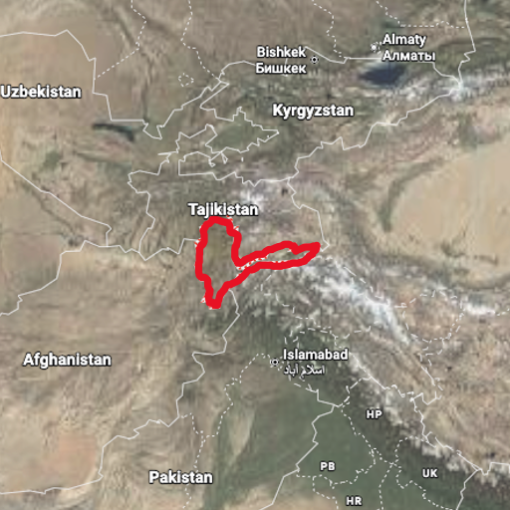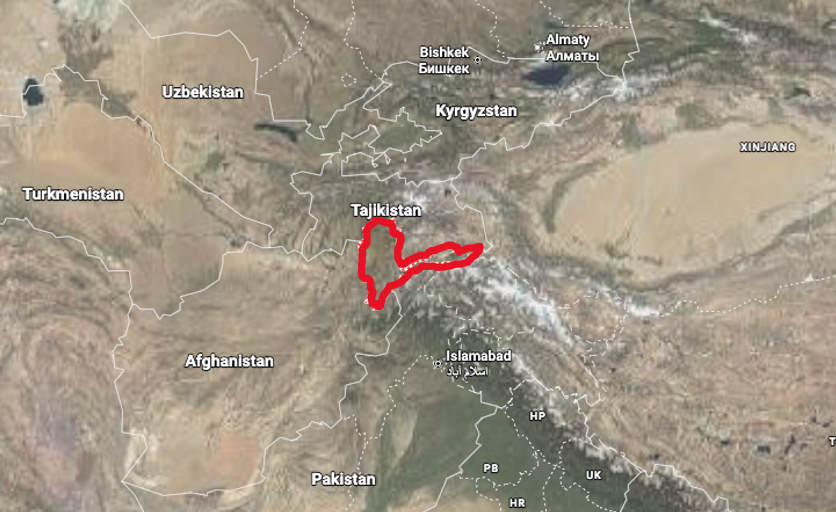

Although Chinese workers have resumed operations in Tajikistan, enhanced security measures remain essential. The Badakhshan region is divided between Tajikistan and Afghanistan. According to the NSBRRI Monitoring and Evaluation team, Gorno-Badakhshan in Tajikistan has recently experienced riots and separatist tendencies. In recent years, the global terrorist group Islamic State Khorasan Province (ISKP) has also established a presence in Tajikistan, with many Tajik nationals implicated in ISKP-linked attacks worldwide. Despite stringent security measures by Tajik authorities, concerns about potential terrorist activity persist. Our monitoring team assesses that any deterioration in the situation in Afghanistan’s Badakhshan Province would directly affect the Tajik side of the region. The Tajik government has already highlighted the presence of Jamaat Ansarullah (also known as the Tajik Taliban) in Badakhshan as a significant threat to regional stability.
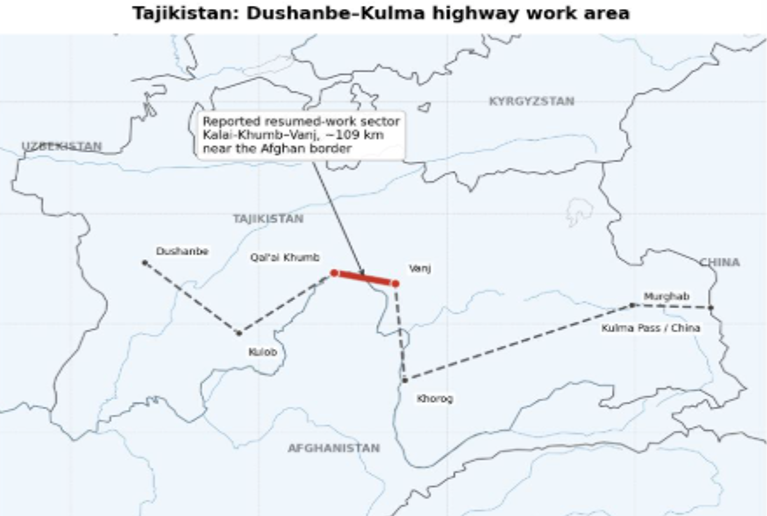
Recently, Tajikistan’s Transport Ministry said Chinese specialists came back in April to the Kalai-Khumb to Vanj section of the Dushanbe-Kulma highway in Gorno-Badakhshan. They are advising local crews, pouring concrete, fitting tunnel lighting and completing other works. The return keeps the China-funded Dushanbe-Kulma corridor moving. The road links Dushanbe with the Kulma Pass on the Chinese frontier through the Pamir. The Kalai-Khumb-Vanj works sit close to the Pyanj River, where attacks from the Afghan side are impacting the cost of Chinese projects.
Why is it important?
Construction on the Kalai-Khumb-Vanj section began on Sept. 20, 2022, with the contract running until September 20, 2026. The contractor is China Road and Bridge Corporation. China is funding the work with a $230 million grant. Once complete, the road section should shrink from 109 kilometres to 92.3 kilometres. It includes two tunnels, five anti-avalanche corridors and 14 bridges.
The route crosses Darvaz, one of Tajikistan’s hardest mountain road sections. The Transport Ministry has described it as a route that had gone for years without major repairs. The work is meant to allow year-round movement and lower fuel and travel costs. By January, crews had finished 12 of the 14 bridges. Two bridges, avalanche corridors and tunnel systems remained under construction.
Why did the work stop?
Work stopped after the November 30, 2025 attack in Shodak, a village in Darvaz district. Tajikistan’s Border Troops said an armed group came from Ruzvayak in Afghanistan’s Badakhshan province and attacked CRBC employees. Two Chinese citizens were killed, and two were wounded. Dushanbe called the attackers members of an armed terrorist group, but did not publicly name the organisation.
Four days earlier, another attack hit Shamsiddin Shohin district in Khatlon, also from Afghan territory. The Chinese embassy said three Chinese citizens were killed and one Chinese citizen was wounded. Media previously reported that Tajikistan described the strike as using an unmanned aerial vehicle carrying explosives.
China reacted with a rare public warning. On December 1, the Chinese embassy urged Chinese companies and personnel to evacuate the Tajik-Afghan border area. Its latest June 9 public warning still told Chinese citizens not to work or travel in Tajikistan’s southern border areas, citing a complex security situation and extreme weather.
Taliban officials later said suspects had been detained in Afghanistan’s Badakhshan province. The Tajik authorities say the border is stable and under control, while continuing to announce smuggling cases and armed incidents.
Current history of violence in the region
The border violence did not start with the road project. NSBRRI M&E team has tracked a series of incidents around Shamsiddin Shohin, a sparsely populated Khatlon district across the Pyanj River from Afghan Badakhshan. The area has long carried illegal narcotics, weapons, stones and other contraband. Recent tensions add gold mining, Chinese business interests and armed groups to that mix.
In November 2024, armed men attacked the Shohin-SM gold mining camp, killing one Chinese worker and wounding others. In August 2025, Tajik border guards exchanged fire with Taliban fighters near Dovang, where gold mining on the Afghan bank had raised disputes over the Panj River’s flow. A later December clash in Shamsiddin Shohin killed two Tajik border guards and three attackers.
The attacks also put pressure on the Russia-led CSTO, which frames Afghanistan’s northern border region as a central security threat. Viktor Vasilyev, chairman of the CSTO Permanent Council, said in June that Afghanistan remained the alliance’s main concern in Central Asia. “We plan to increase our joint efforts here, including to neutralise the militants and extremist groups that continue to accumulate on Afghanistan’s northern borders,” he said, according to the Russian media outlet TASS.
The CSTO has promised more support for Tajikistan’s frontier. Media reported in September 2025 that the alliance plans to begin sending weapons and military equipment for the Tajik-Afghan border in 2026. The program runs through 2029 and covers logistics, communications, and border infrastructure.
In March, Tajik lawmakers approved a Chinese-funded plan to build nine border facilities near Afghanistan. The project is valued at more than 550 million somoni, or about $57.4 million. It includes access roads, water, drainage, electricity and equipment. Chinese funding also helped build twelve Tajik border installations in 2017 and 2018.
Why does it matter for China, Tajikistan, Afghanistan, and Russia?
The road’s restart shows how closely Tajikistan’s economic projects now sit beside its security problems. Dushanbe needs the road for links to Gorno-Badakhshan and China, while Beijing wants its citizens protected before its companies return to work. Kabul, meanwhile, wants to show it can police militants and criminals on Afghan soil, while Moscow and the CSTO want to remain central to Tajik border security.
Those pressures meet in Darvaz. The crews are back, but the road now depends on more than concrete and mountain engineering. It depends on armed Tajik protection and Taliban promises.
Recommendations
- China, Tajikistan, and Afghanistan should strengthen joint monitoring and security cooperation in the shared Badakhshan region.
- The use of quadcopters (drones) in terrorist attacks is increasing. One recent attack on Chinese workers was carried out using a drone. Therefore, regional stakeholders should develop robust drone monitoring systems and effective counter-drone strategies.
- Gaining local support is essential. Chinese investors should actively work to win the hearts and minds of the Pamiri people through community engagement and development initiatives.
- Drug trafficking networks in the region remain a significant security concern. China, Tajikistan, and Afghanistan should intensify joint efforts to disrupt these networks and enhance border control and coordination.