
|
**Now open for Audience Registration – FREE for all attendees**
|
|
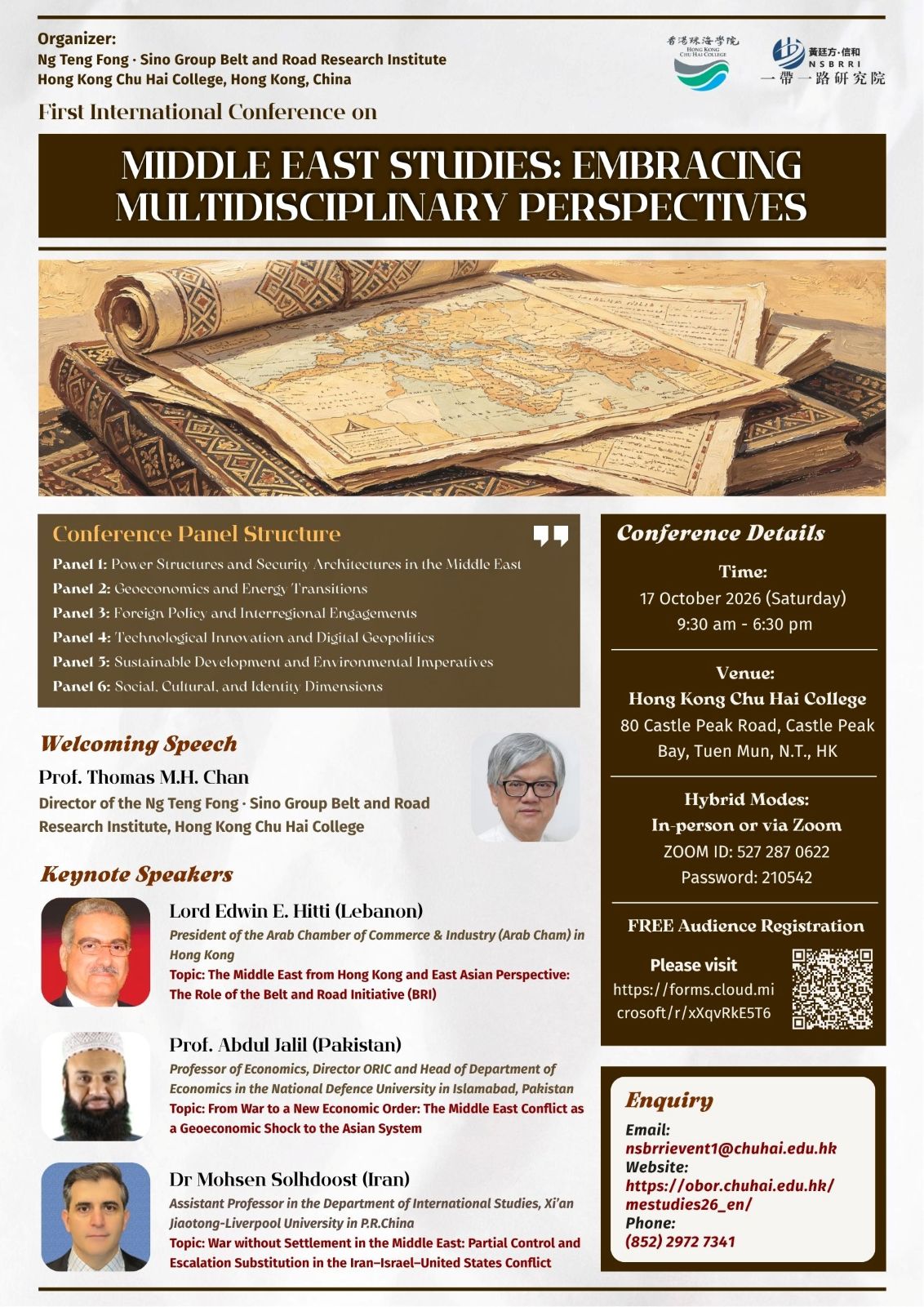
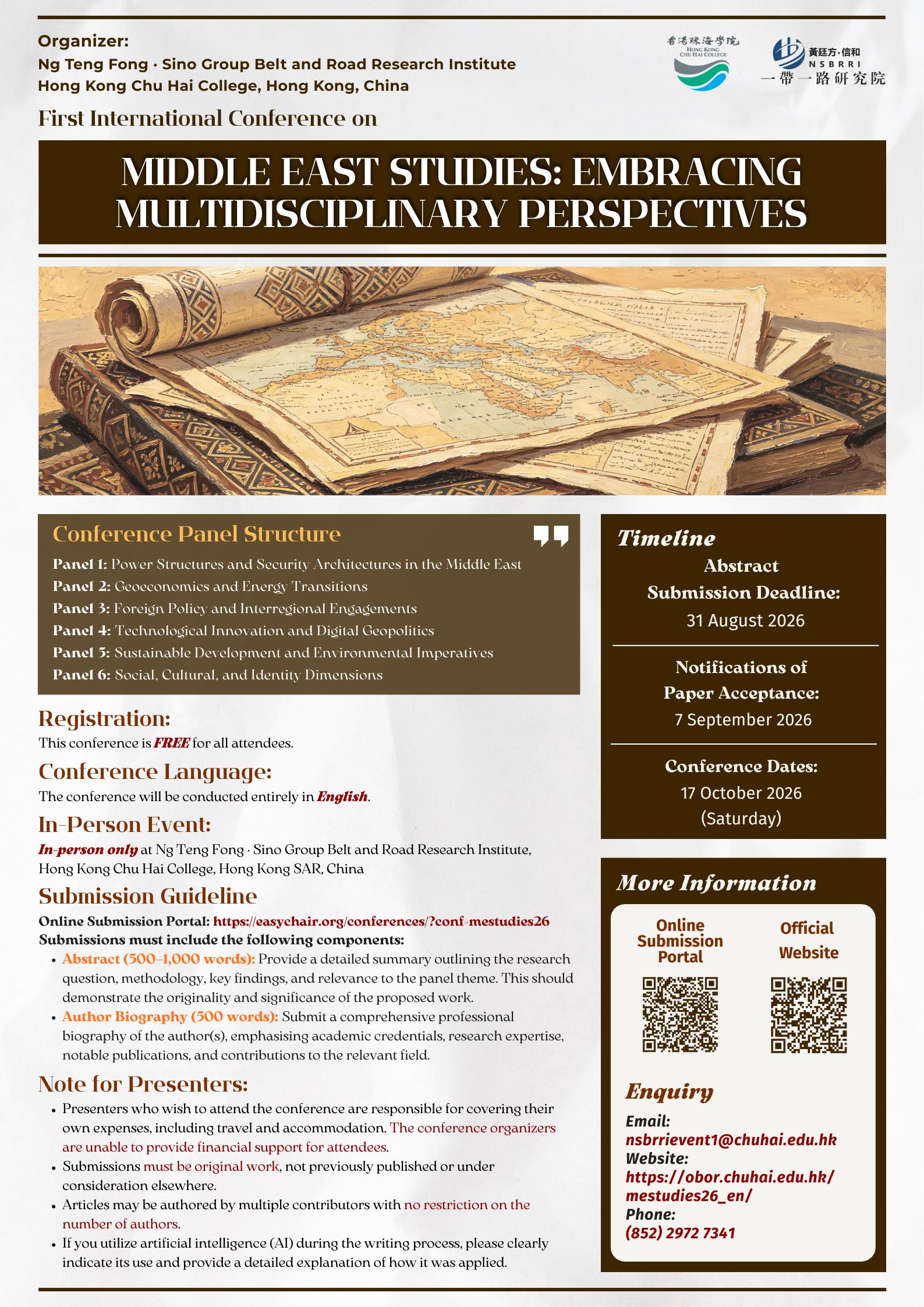
First International Conference on “Middle East Studies: Embracing Multidisciplinary Perspectives” In-Person Event In-person at Ng Teng Fong · Sino Group Belt and Road Research Institute, Hong Kong Chu Hai College, Hong Kong SAR, China.
Timeline Abstract Submission Deadline: 31 August, 2026 Notifications of Paper Acceptance: 7 September, 2026 Conference Dates: 17 October, 2026 (Saturday)
Organized by Ng Teng Fong · Sino Group Belt and Road Research Institute, Hong Kong Chu Hai College, Hong Kong SAR, China.
Overview The International Conference on Middle East Studies invites scholars, researchers, policymakers, and practitioners from around the world to submit original, unpublished papers that explore the multifaceted dimensions of the Middle East in a rapidly evolving global context. The conference seeks to foster interdisciplinary dialogue, bridging traditional silos in Middle East studies with insights from international relations, economics, political science, sociology, environmental studies, technology, and beyond. In an era marked by geopolitical realignments, economic interdependencies, technological disruptions, and sustainability imperatives, the Middle East stands at the crossroads of global transformations. This conference will interrogate how regional dynamics intersect with broader international forces, examining opportunities for collaboration, resilience, and innovation. We encourage submissions that challenge conventional narratives, incorporate diverse methodological approaches (e.g., quantitative modeling, qualitative case studies, comparative analyses), and amplify underrepresented voices from the Global South. This first International Conference is free of charge for all accepted presenters and attendees, underscoring our commitment to accessibility and inclusivity. However, as an in-person event, participants are responsible for their own travel, accommodation, and related expenses.
Submission Guidelines Submissions must include the following components: Abstract (500–1,000 words): Provide a detailed summary outlining the research question, methodology, key findings, and relevance to the panel theme. This should demonstrate the originality and significance of the proposed work. Author Biography (500 words): Submit a comprehensive professional biography of the author(s), emphasizing academic credentials, research expertise, notable publications, and contributions to the relevant field.
Online Submission Portal: https://easychair.org/conferences/?conf=mestudies26 All submissions will undergo a double-blind peer review process. Authors will be notified of acceptance decisions via email.
Registration This conference is free for all attendees.
Note for Presenters Presenters who wish to attend the conference in person are responsible for covering their own expenses, including travel and accommodation. The conference organizers are unable to provide financial support for attendees.
Language of the Conference The conference will be conducted entirely in English. All presentations, papers, and discussions must be prepared and delivered in English to ensure clear communication and accessibility for all participants.
Conference Panel Structure The conference is organized around the following thematic panels to encourage focused discussions: Panel 1: Power Structures and Security Architectures in the Middle East Panel 2: Geoeconomics and Energy Transitions Panel 3: Foreign Policy and Interregional Engagements Panel 4: Technological Innovation and Digital Geopolitics Panel 5: Sustainable Development and Environmental Imperatives Panel 6: Social, Cultural, and Identity Dimensions
Suggested Topics Panels may address (but are not limited to) the following topics: 1. Contemporary Power Dynamics in the Middle East: Shifts, Alliances, and Hegemonic Contestation 2. Interregional Connectivity: East and Southeast Asian Engagements with the Middle East in the 21st Century 3. S. Foreign Policy Toward the Middle East: From Unipolar Dominance to Multilateral Retrenchment 4. Security Architectures and Economic Interdependencies in the Persian Gulf: Risks and Resilience 5. The Agency of Middle Powers in the Middle East: Balancing Autonomy and Alliances in Regional Power Structures 6. The Middle East in Global Supply Chain Disruptions: Vulnerabilities, Diversification, and Strategic Autonomy 7. China’s Belt and Road Initiative in the Middle East: Infrastructure Diplomacy and Geopolitical Implications 8. Great Power Competition in the Middle East: Proxy Conflicts, Arms Races, and Spheres of Influence 9. Technological Innovation and Disruption in the Middle East: AI, Cybersecurity, and Digital Sovereignty 10. Sustainable Development Trajectories in the Middle East: Policy Innovations Amid Resource Constraints 11. Geoeconomics and Geopolitics of Energy Transitions: From Fossil Fuels to Renewables in the Middle East 12. Sanctions Regimes and Economic Statecraft: Efficacy, Evasion, and Human Costs in the Middle East 13. Regional Economic Blocs and Pathways to Geopolitical Integration in the Middle East 14. Resource Scarcity and Geoeconomic Rivalries: Water, Food, and Energy Conflicts in the Middle East 15. Climate-Induced Geoeconomic Shifts: Adaptation Strategies and Vulnerabilities in the Middle East 16. Digital Diplomacy and Cyber Geopolitics: Middle Eastern States in the Age of Information Warfare 17. Migration, Diaspora Networks, and Soft Power Projection from the Middle East 18. Cultural Heritage as a Geopolitical Asset: Preservation, Looting, and Narratives in the Middle East 19. Gender Dynamics in Middle Eastern Geopolitics: Women’s Agency in Conflict Resolution and State-Building 20. The Role of Non-State Actors: Transnational Jihadism, Hezbollah, and ISIS in Reshaping Regional Security 21. Israel-Palestine Conflict: Pathways to De-escalation in a Fragmented International Order 22. Iran’s Foreign Policy: Past, Present, Future 23. Sectarianism and Identity Politics: Sunni-Shia Divides in Contemporary Middle Eastern Alliances 24. The Arab Spring’s Legacies: Democratic Backsliding, Authoritarian Resilience, and Youth Activism 25. Maritime Security in the Red Sea and Suez Canal: Piracy, Blockades, and Global Trade Implications 29. Indigenous Knowledge and Environmental Governance 30. Arms Trade and Military Industrialization: Self-Reliance Efforts in the Middle East 31. Media and Propaganda in Middle Eastern Conflicts 32. Economic Diversification Beyond Oil: Knowledge Economies and Innovation Hubs in the Persian Gulf 33. Human Rights and Transitional Justice: Accountability Mechanisms Post-Conflict in the Middle East 34. Space Exploration and Satellite Diplomacy: Middle Eastern Investments in Orbital Geopolitics 35. Decolonizing Middle East Studies: Epistemic Shifts and Southern Theory in Global Academia *Submissions should align with one or more panels and may propose new topics for consideration.
Additional Notes 1. Submissions must be original work, not previously published or under consideration elsewhere. 2. Articles may be authored by multiple contributors with no restriction on the number of authors. 3. If you utilize artificial intelligence (AI) during the writing process, please clearly indicate its use in the submission cover letter and provide a detailed explanation of how it was applied (e.g., for drafting, editing, or data analysis).
Conference Websites
|
You may also like
**Please note that the contact email has been changed to nsbrrievent3@chuhai.edu.hk. We apologise for any inconvenience caused** ***Abstract Submission Deadline Extended by […]

**Please note that the contact email has been changed to nsbrrievent2@chuhai.edu.hk. We apologise for any inconvenience caused** ***Abstract Submission Deadline Extended*** Call For […]
**Please note that the contact email has been changed to nsbrrievent4@chuhai.edu.hk. We apologise for any inconvenience caused** ***Abstract Submission Deadline Extended […]
Latest News (Updated: 17 August 2026) Proceedings Volume 1 Volume 2 Volume 3 ——————————— Abstract Book Please download the abstract book for […]