
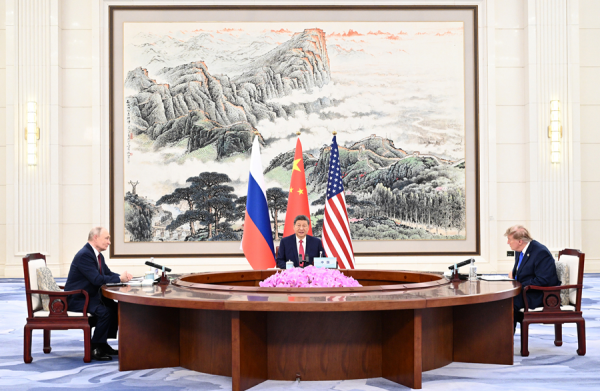
The Asia-Pacific Economic Cooperation (APEC) 2026 Summit concluded in Shenzhen, China, on November 19, 2026. On the afternoon of November 19, Chinese President Xi Jinping, along with Russian President Vladimir Putin and US President Donald Trump, held a trilateral summit and engaged in in-depth discussions on the theme of “Safeguarding World Peace and Promoting Strategic Stability in Major-Power Relations.”
Key outcomes of the two summits
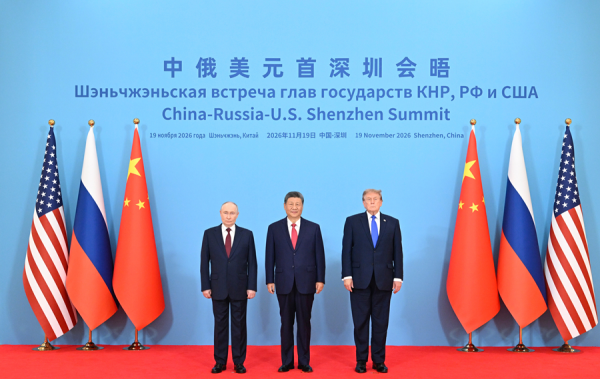
First: Outcomes of the trilateral summit and the “Declaration of Peace”
The trilateral meeting was held at Villa Kielen in Shenzhen and lasted approximately 90 minutes. It concluded with a joint official statement entitled “Declaration of the Heads of State of the United States, Russia, and China Towards Peace,” which included the following points:
- Reducing nuclear risks: The three leaders reaffirmed the principle that “nuclear war cannot be won and must never be fought,” and pledged to initiate a formal joint dialogue to reduce nuclear risks and prevent the proliferation of weapons of mass destruction.
- Stability of energy markets and supplies: The three countries agreed on the importance of maintaining stable global energy flows and announced plans to increase the production and supply of refined petroleum products to enhance international energy security.
- Reform of the United Nations: As permanent members of the Security Council, the leaders committed to supporting the reform of the United Nations to make it more effective in addressing global challenges and maintaining international peace and security. • Stance on the International Criminal Court: The declaration explicitly stated the three countries’ agreement that “the International Criminal Court and similar institutions must not abuse their powers,” a clause observers considered a safeguard for the principle of national sovereignty and the immunity of officials.
- Issues Omitted from the Official Text: The final declaration made no mention of “Ukraine” or specific steps to end the conflict with “Iran,” despite discussions during the closed session.
Second: APEC 2026 Summit Outcomes and the “Shenzhen Outlook” Statement
At the conclusion of the 33rd meeting, the leaders of the 21 member economies adopted the official final declaration entitled “Shenzhen Outlook 2026: Building an Asia-Pacific Community to Prosper Together,” along with three final documents on trade, connectivity, and innovation:
- Free Trade Area and Anti-Protectionism: The leaders reaffirmed their commitment to strengthening the resilience of supply chains, continuing to work towards the establishment of the Free Trade Area of the Asia-Pacific (FTAAP), and supporting the multilateral trading system based on the World Trade Organization.
- Artificial Intelligence and Digital Transformation: The forum launched the “APEC AI Initiative (2026–2030)” and adopted a declaration to harness digital and emerging technologies to create jobs and boost productivity, while emphasizing the protection of intellectual property and facilitating cross-border data flows.
- Chinese Pledges: President Xi Jinping announced China’s contribution of US$20 million to support practical cooperation projects within APEC, the establishment of a Center for Asia-Pacific Society Studies in Shenzhen, and the creation of cooperation bodies in the areas of clean energy, digital technology, and the development of small and medium-sized enterprises (SMEs).
- Business Sector Initiative: The APEC CEO Summit, for the first time in its history, issued the “Shenzhen Initiative,” calling for deeper economic opening-up and the promotion of green and digital transformation.
Third: Key Bilateral Meetings and Agreements on the Sidelines
- US-China Understanding: During their bilateral meeting, Presidents Donald Trump and Xi Jinping agreed to formulate an action plan to achieve “strategic stability” between the two countries. Trump affirmed that his country does not support Taiwanese independence, while markets awaited an extension of the trade truce scheduled to expire in January 2027.
- US Energy and Trade Deals: Trump announced the signing of more than 20 trade agreements, most notably the launch of a massive liquefied natural gas (LNG) project in Alaska to supply Asian markets with low-cost fuel.
- Russian Commitments: President Putin affirmed Moscow’s commitment to ensuring stable energy, grain, and fertilizer supplies to Asia-Pacific economies as a strategic choice.
Following the summit, the three countries issued a declaration by the heads of state of China, Russia, and the United States toward peace.
An Analysis of the Summit’s Outcomes
The most significant and fundamental implication is that the summit revealed the limits of any party’s ability—including the United States—to impose its choices or resolve international conflicts unilaterally. The implicit acknowledgment of the inability of a single power to impose its will represents a structural shift in the perception of major powers. The economic and military costs of mutual attrition, coupled with the complexities of supply and energy chains, have compelled the three capitals to shift from a “zero-sum” approach to one of “managing competition and sharing the costs.”
US Objectives
Washington is acting out of pragmatic realism to avoid being drawn into multi-front confrontations that would deplete its resources. Through dialogue, it seeks to stabilize energy markets, control the nuclear arms race, and prevent the formation of a solid and closed Sino-Russian alliance against it. However, this negotiation does not signify abandoning its strategy of “technological and economic containment” of China, nor its security commitments to its traditional allies in Europe and Asia. A genuine shift in America’s stance toward China and Russia will be measured by amending legislation and sanctions (such as easing tariff and technological restrictions or modifying financial sanctions). Simply forming joint working groups and toning down media rhetoric without altering the legal and military framework of containment means that the meeting is merely a tool for crisis management and buying time diplomatically.
Are we witnessing a tripolar system?
The meeting of leaders does not automatically give rise to a tripolar system. The international order only changes if the distribution of overall power (economic, technological, and military) shifts, and if the rules of decision-making and international financial institutions (such as the global payment system and the structure of the Security Council) are altered to reflect this new balance. What we are currently witnessing is “asymmetric multipolarity” or a tripolar management of major crises.
The international system cannot be understood or managed in isolation from Europe, India, and other regional powers. India represents a demographic, economic, and strategic counterbalance in Asia, while Europe remains an indispensable economic and organizational partner. Meanwhile, regional powers (such as the Gulf states and Turkey) control key waterways and energy resources, and their ability to maneuver and remain neutral allows them to either disrupt or facilitate any agreement among the major powers.
China’s Gains
China’s gains from the trilateral summit include: easing the pressure of Western encirclement and solidifying its image as a “responsible power and a bridge for international communication” capable of uniting opposing sides, which enhances its moral influence among the countries of the Global South. However, for Beijing to move from “host of the meeting” to “influencer of outcomes,” we must see a practical commitment from the conflicting parties to Chinese guarantees. The defining characteristic of this will be Beijing’s success in extracting tangible concessions (such as a sustainable ceasefire or a reversal of escalatory actions in waterways) through its economic and diplomatic weight, rather than simply hosting photo opportunities and issuing public statements.
The trilateral declaration’s focus on “energy stability” and its disregard for the path to resolving the conflict with Iran sends a warning message to the Gulf Arab states: that major powers may agree to neutralize oil wells and export routes to protect the global economy, while leaving regional conflicts and proxy wars to simmer or be managed at a low level. What to watch in US policy: The rules of military engagement and actual deterrence in the Red Sea and the Strait of Hormuz must be monitored, as well as Washington’s seriousness in ending the war, not just its diplomatic pronouncements. The security of the Persian Gulf should not be reduced to “security of supply,” but any international agreement must encompass national sovereignty, comprehensive maritime security, and non-interference in the internal affairs of the region’s countries.
UN reform and officials’ immunities
The danger lies in UN reform becoming a power-sharing deal that entrenches the dominance of the permanent members of the Security Council at the expense of the UN General Assembly. The true guarantee for countries not represented on the Security Council is linking any structural reform to expanding equitable geographical representation (granting permanent seats or broader powers to marginalized continents such as Africa, the Arab world, and Latin America) and restricting the use of the veto in matters of peace and human security.
The immunity clause for officials carries a mix of protecting the principle of national sovereignty and preventing the politicization of international justice or the use of arrest warrants as a tool of political pressure against heads of state. On the other hand, it practically opens the door to narrowing the scope of international accountability and shielding officials from legal prosecution, reflecting the desire of major powers to establish “safe rules of engagement” for their ruling elites.
China’s Balance and the Sustainability of Nuclear and Energy Cooperation
China maintains its balance by separating its various tracks. It provides Russia with an economic and trade lifeline without direct military involvement, and it maintains trade channels with Washington while avoiding confrontation. The common ground for these three countries is preventing comprehensive catastrophes (nuclear war, global economic collapse, and energy security). However, a sharp American escalation on the Taiwan issue or the imposition of comprehensive secondary sanctions on major Chinese banks could shatter this balance, pushing Beijing toward a comprehensive alliance with Russia. This cooperation among the three major powers can continue even with intensifying technological competition, because both issues represent an “existential survival interest.” Nuclear escalation threatens everyone with annihilation, and an energy crisis devastates both the Chinese and American economies. What safeguards this cooperation is separating the issues of survival (nuclear deterrence and energy) from those of superiority (microchips and artificial intelligence).
The Expected Scenario: The most likely scenario among the three major powers is limited understandings on specific issues, while structural competition continues. The ideological and strategic gap is too deep to allow for comprehensive institutional cooperation, and at the same time, the cost of a full-scale confrontation prevents a return to open escalation. The indicator to monitor is the movement of trade, tariffs, and technology supply chains over the next six months, in addition to the level of de-escalation in hotspots. If sanctions and technological escalation persist, the summit will amount to nothing more than a temporary truce. To prevent the summit’s announcement from being dictated by the whims of the leaders, the dialogue must be institutionalized through a permanent secretariat or regular ministerial working groups bound by a timetable. Furthermore, understandings should be linked to cross-border economic and trade agreements that would make the cost of withdrawal prohibitively high for any future administration.
China’s Practical Role in the Middle East
What China can practically offer, in addition to trade, is its possession of an undeclared economic and diplomatic leverage over regional actors who rely on it. Economically, China can contribute to reconstruction initiatives contingent on stability, and provide surveillance technologies and security for borders and waterways. However, the limits of China’s role lie in “cautious neutrality.” Beijing does not want to become militarily involved or play the role of “regional policeman” in place of Washington, and it fears losing any party (Iran, the Arab states, or Israel), which leads it to avoid imposing coercive solutions.
China could sponsor a regional security agreement that includes verification mechanisms and economic guarantees, such as successfully establishing a permanent ceasefire in the Red Sea or reaching a regional security understanding among the Gulf states, along with offering investment and development packages, like offering major Chinese investment and development packages as incentives to Iran and Yemen, for example.