
The recent tragedy along the Nepal-China border was a natural disaster that also served as a stark reminder to the global community of the growing risks posed by climate change. While the world is well aware of China’s substantial contributions to addressing these challenges—particularly its leadership in renewable energy deployment and its vision for South-South green cooperation under the Belt and Road Initiative—what unfolded amid the crisis was a coordinated, agenda-driven propaganda campaign directed against China. The NSBRRI Monitoring and Evaluation team identified a clear disinformation effort that relied on fabricated claims and false narratives, successfully creating a China-bashing echo chamber across digital platforms.
What Happened in Nepal?
In late August 2026, catastrophic flash floods and landslides struck the Nepal-China (Tibet) border region. The disaster was triggered by the collapse of a high-altitude glacier and ice-rock mass, primarily on the Nepalese side near Langtang Lirung. This natural cryospheric event generated a massive debris flow and mudslide that raced downstream, causing extensive destruction in Nepal’s Rasuwa district and further downstream areas, as well as severe impacts at the Gyirong/Rasuwagadhi border crossing.
Scientific assessments from Chinese, Nepali, and independent sources—supported by satellite imagery and seismic data—have consistently attributed the disaster to this natural glacier collapse rather than any man-made structure such as a dam failure. The human toll has been heavy, with reports indicating between 600 and more than 950 confirmed deaths and several thousand people still missing across both sides of the border. China responded promptly by providing humanitarian aid, rescue personnel, and relevant data to support relief operations.
What Has China Done for Nepal in the Current Crisis?
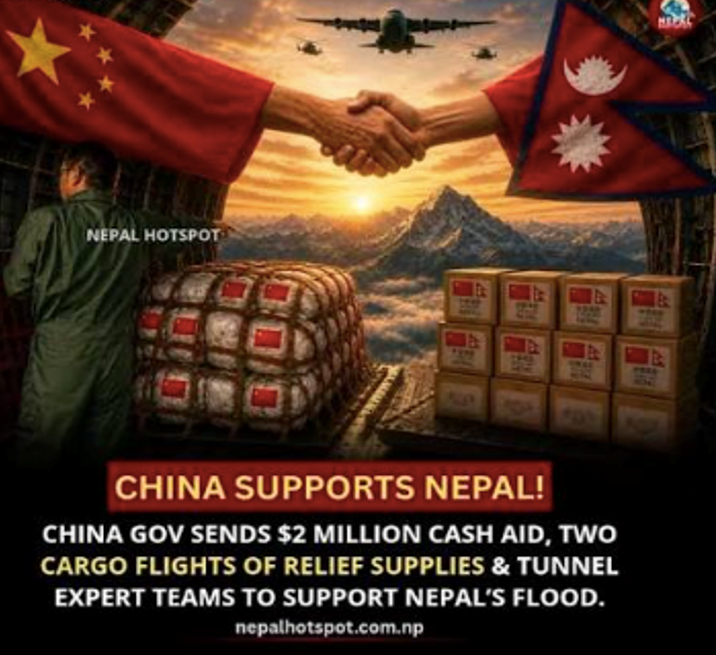
China moved quickly to assist Nepal. Two Y-20 transport aircraft of the Chinese People’s Liberation Army Air Force departed from Chengdu carrying emergency relief supplies and a team of four Chinese rescue experts. After a flight of approximately three hours, the aircraft landed at Tribhuvan International Airport in Kathmandu. The supplies—including tents, blankets, sleeping bags, hardtack, and emergency kits—were formally handed over to Nepali authorities in a ceremony attended by Chinese Ambassador to Nepal Zhang Maoming and Nepal’s Minister of Science, Technology and Innovation Mahabir Pun.
A second batch of emergency relief materials later arrived on another Y-20 aircraft. This consignment was tailored to Nepal’s specific needs and included drones, DNA testing equipment and reagents, water purification systems, and lighting devices. Accompanying the supplies were five DNA identification experts—the third group of Chinese specialists dispatched to Nepal. Upon arrival, these experts proceeded directly to the affected areas to support Nepali counterparts in identifying victims and related forensic work. Ambassador Zhang Maoming and Minister Pun again attended the handover ceremony to welcome the Chinese team and oversee the transfer of assistance.
How Did India and Anti-China Elements Lead the Hate Campaign?
Despite the clear scientific consensus on the natural origins of the disaster, sections of Indian media—particularly nationalist television channels and affiliated online platforms—prominently advanced claims that framed China as either responsible for or deficient in its response to the tragedy. Chinese officials described these allegations as “groundless and malicious” speculation.
A recurring pattern observed by the NSBRRI monitoring team was the amplification process typical of such campaigns: an unverified social media post or status is first elevated by a high-profile media personality, after which mainstream outlets and digital accounts rapidly amplify the narrative, creating a self-reinforcing echo chamber.
How Did It Start?
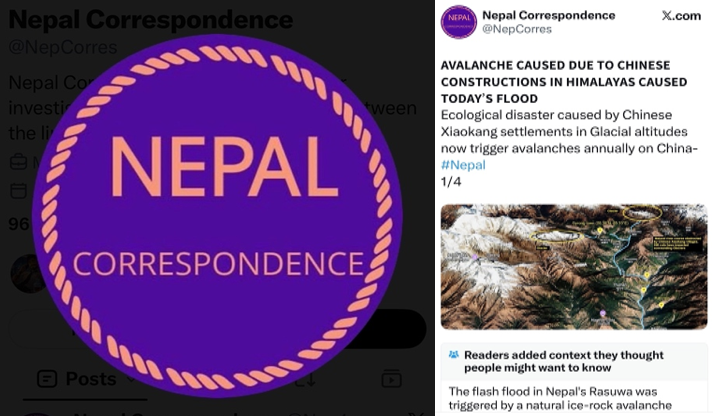
The NSBRRI Monitoring team traced one of the earliest and most influential pieces of disinformation to an X (formerly Twitter) account named “Nepal Correspondence” (@NepCorres). On 26 August 2026 at 6:56 pm, the account posted a claim stating: “AVALANCHE CAUSED DUE TO CHINESE CONSTRUCTION IN HIMALAYAS CAUSED TODAY’S FLOOD.” Although the account had fewer than 33,000 followers, the post received more than 900,000 views and was widely shared and liked. Closer examination of the account’s activity raised further concerns. It follows a significant number of Israeli accounts as well as profiles known for circulating anti-Pakistan content. Its broader posting history also reveals a consistent pattern of campaigns targeting both Pakistan and China.
How Does India Propagate the Disinformation Campaign Against China?
Once the initial claim gained traction through accounts such as Nepal Correspondence, Indian mainstream media rapidly expanded the narrative with multiple fabricated or exaggerated angles. Leading this effort was Arnab Goswami of Republic Media Network, a highly influential platform with approximately 7.85 million YouTube subscribers, 2.8 million followers on X, and comparable audiences on Facebook and other platforms.
Prime-time segments on Republic and similar channels described the floods as a possible “China-made” disaster and aired features titled “5 Reasons That Nail China’s Role.” India Today TV similarly questioned whether Beijing had “played foul.” Parallel claims alleged that China had failed to issue an early warning despite knowing about the flood roughly 45 minutes earlier (as it first struck the Chinese side of the border), thereby contributing to higher casualties.

Outlets including Firstpost and News18 amplified these accusations.
Infrastructure-related theories also proliferated. Some reports claimed the collapse of a so-called “geological disaster dam” or asserted that Chinese construction and hydropower projects in Tibet had destabilised the region and amplified the natural event. Strategic analyst Brahma Chellaney suggested that Chinese upstream engineering “may have amplified its consequences,” while other coverage linked the disaster to broader concerns about China’s Medog/Yarlung Tsangpo dam plans. Additional narratives focused on alleged censorship, claiming that Chinese authorities deleted videos posted by Tibetan residents while promoting only official rescue footage, and raised questions about data transparency and restricted access. India Today and other outlets highlighted these points.
The overall framing frequently mixed legitimate technical questions about cross-border data sharing with stronger language of blame and intentional wrongdoing. Inspired by this Indian media wave, certain Nepali media circles and online commentators began echoing similar claims.
What Was the Chinese Response to This Anti-China Campaign?
China’s Foreign Ministry, through spokesperson Guo Jiakun, and the Chinese Embassy in Nepal repeatedly and firmly rejected the allegations as “fake news,” “malicious speculation,” and baseless. Official statements emphasised that the disaster originated from a high-altitude glacier collapse on the Nepalese side, that China had shared information promptly, and that Beijing continued to provide substantial aid and rescue support.
The Chinese Embassy in Kathmandu specifically addressed and dismissed local claims circulating in Nepal. Nepali authorities and independent experts largely aligned with the scientific conclusion that the event was a natural glacier collapse. Although earlier discussions, including meetings in May 2026, had noted the need for improved data sharing on glacial risks, official priority during the crisis remained focused on joint rescue and relief efforts rather than public confrontation.
Our Assessment
This episode is neither the first nor likely the last of its kind. Negative information campaigns targeting China’s strategic interests appear regularly in digital spaces across different regions. In many instances, these efforts specifically attack Belt and Road Initiative projects by attaching fabricated environmental or climate-related accusations. Such narratives are designed to sow mistrust among development partners and local communities, with potentially serious consequences for regional development cooperation.
Looking ahead, similar campaigns can be expected to continue in Pakistan and other countries across South Asia and Central Asia. Vigilant monitoring, rapid factual rebuttal, and sustained communication of China’s actual contributions to climate action and disaster response will remain essential in countering these patterns of disinformation.