
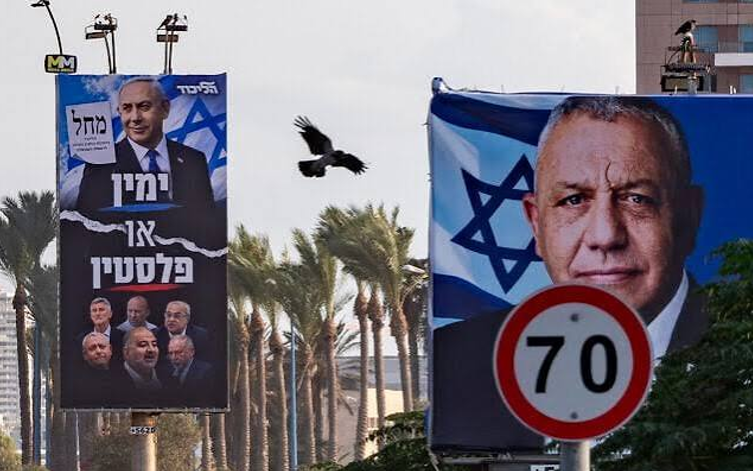
The vote count began after polling stations closed in the Israeli Knesset elections, with a turnout of nearly 77%. The elections witnessed fierce competition between Prime Minister Benjamin Netanyahu’s bloc and the opposition bloc led by former Chief of Staff Gadi Eisenkot.
In the preliminary results, Netanyahu’s bloc (the far right) and Eisenkot’s bloc (the less far right) are tied, each securing between 53-49 and 51-51 seats, respectively. Meanwhile, the two Arab lists achieved historic results, winning 18 to 19 seats. Thus, as pre-election polls indicated, no bloc won a majority of 61 seats. However, Eisenkot’s bloc could rely on the support of the Arab lists to form a government, securing a parliamentary majority and a safety net for the government. If tasked with forming the government, Netanyahu will likely attempt to entice some smaller right-wing or religious parties to join his coalition or form a national unity government with a rotating premiership with Eisenkot. Channel 12, which supports Netanyahu, is reporting different results, showing Netanyahu’s bloc leading with 53 seats compared to Eisenkot’s bloc’s 49. Official results are expected before Tuesday, November 4, but some ballot boxes will not be counted for several days, which could make a difference.
Possible Scenarios:
- Israeli President Chaim Herzog may task Eisenkot with forming a government, given that he would have the support of the two Arab lists (18-19 seats), while these lists cannot support Netanyahu. Eisenkot could also form a coalition with the Shas ultra-Orthodox party, which represents Sephardic Jews, to form a government.
- Netanyahu will claim that he is the leader of the largest party, not the largest bloc, and therefore has the right to form a government. If Eisenkot fails to form a government, new elections could be held after six months or more, extending Netanyahu’s term.
- One scenario, favoured by Trump, is the formation of a national unity government between Netanyahu and Eisenkot. This would keep Netanyahu in power through a rotating premiership, allowing him to continue the war/mission, as Trump calls it, against Iran. Netanyahu might also assume the foreign ministry portfolio.
- Another scenario is that Netanyahu will question the election results and resort to creating chaos to demand a new election. This would keep him in power longer until the crisis is resolved or new elections are held, which he hopes will improve his electoral standing. In the meantime, Netanyahu might escalate tensions on multiple fronts, from Gaza and the West Bank to Lebanon and Iran.
Key Developments:
The Central Elections Committee announced a 77.7% voter turnout in the Israeli elections, the highest since the 1999 elections.
Israel’s Channel 12 reported that preliminary results of the Knesset elections indicate a high probability that Gadi Eisenkot will form the next government.
The Maariv newspaper suggested that Eisenkot would be the first to receive the mandate to form a government from the president.
Exit polls from Israel’s Channel 12 showed Prime Minister Benjamin Netanyahu’s bloc winning 53 seats, compared to 49 for the Change bloc led by Gadi Eisenkot, while the Arab parties were projected to win 19 seats.
Yedioth Ahronoth reported that Likud received 24.1% of the vote, compared to 16.1% for Eisenkot’s Yesh Atid party, after nearly one million votes were counted.
Prime Minister Benjamin Netanyahu said he was awaiting the official election results, asserting that they would show Likud as the largest party in Israel and that the right-wing bloc had a decisive majority. He added, “A strong national unity government must be formed.”
Opposition leader Gadi Eisenkot said Netanyahu’s political career was over, adding, “He should not use Israel’s security for his own political gain.”
Channel 12 quoted a source as saying that the ultra-Orthodox parties did not rule out cooperating with Gadi Eisenkot if he formed a government. Polling stations closed on schedule in the Israeli Knesset elections after the Central Elections Committee rejected the Likud party’s request to extend voting, which ended at 10:00 PM local time.
The Elections Committee has finished counting approximately one million votes, representing 16.8% of the total votes cast.
The highest voter turnout since 1999
The voter turnout in the Israeli Knesset elections reached 77.7% by 10:00 PM on Tuesday, according to Channel 12, marking the highest turnout since 1999 amidst sharp political and social polarization regarding the identity and future of the political system.
Experts believe that the record-breaking voter turnout stems from the fact that the election is about the future of the State of Israel’s existence, not who governs it, and from fears of the political system becoming authoritarian.
Will the Haredi parties cooperate with Eisenkot?
Sources on Israel’s Channel 12 revealed that the ultra-Orthodox religious parties are prepared to cooperate with Gadi Eisenkot’s bloc should he succeed in forming a government. This pragmatic shift reflects the religious community’s historical priority of protecting the budgets of their religious seminaries and avoiding military service, from which they have enjoyed exemption for decades, even during Benjamin Netanyahu’s government.
Political analysts have expressed doubt about Eisenkot’s ability to accept the participation of the religious parties without betraying his voters. The opposition has built its entire legitimacy on legislation for universal conscription, especially given the growing impatience of the Israeli public due to the burdens of the long war, the deaths of nearly a thousand soldiers, and the wounding of more than 26,000 others. This makes the inclusion of the ultra-Orthodox a dilemma that threatens to unravel the new coalition.