
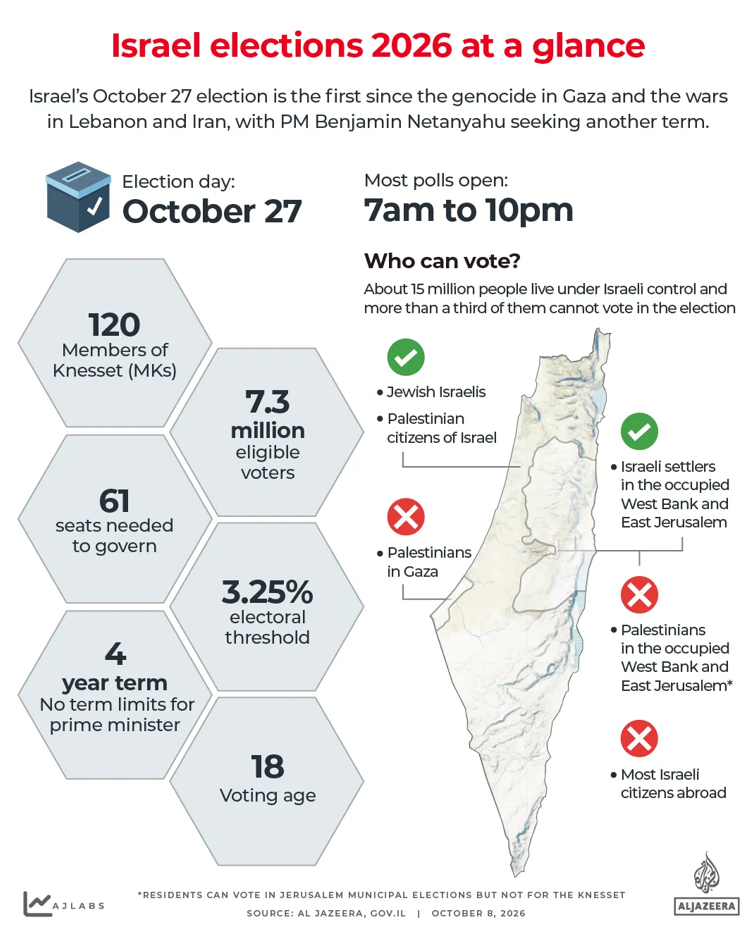
Israelis are heading to the polls today, Tuesday, October 27, 2026, to elect members of the 26th Knesset. Thirty-eight lists are competing for the 120 seats.
According to the Central Elections Committee, 7,331,981 Israelis are eligible to vote, a net increase of 543,177 voters compared to the November 2022 elections.
Every Israeli citizen aged 18 and over who is registered in the voter registry is eligible to vote, including Palestinians with Israeli citizenship and Israeli settlers in the occupied Palestinian territories.
Data from the Central Bureau of Statistics reveals that approximately 6.5 million registered voters reside within Israel, while about 810,000 live abroad.
Demographics
The data shows that Jews constitute 77% of eligible voters residing within Israel, totaling approximately 5,017,000 voters, including 684,000 Haredim (ultra-Orthodox Jews). The number of Arab (Palestinian) voters, including Muslims, Arab Christians, and Druze, is approximately 1,159,000, representing 18% of the electorate. An additional 346,000, or 5%, fall into other categories, including non-Arab Christians and individuals without a religious affiliation.
The age distribution is as follows: 15.1% are aged 18-24, 27.6% are aged 25-39, 31% are aged 40-59, and 26.3% are 60 years of age or older.
New Voters
Young people voting for the first time in the 2026 elections are a prominent group. The Israel Democracy Institute estimated their number at approximately 640,000, while an analysis by the company Points estimated it at around 595,000. According to an analysis by Points, women constitute 50.9% of new voters, approximately 303,000, compared to 49.1% for men, approximately 292,000.
Voting Abroad
Although there are approximately 810,000 registered voters residing abroad, Israeli law does not permit general voting through embassies or by mail. Overseas voting is limited to government employees, official missions, certain national institutions, and their eligible family members. One hundred and one polling stations were set up in 99 diplomatic missions for approximately 4,800 eligible voters, and voting began 12 days before the general election.
Thus, most Israelis residing abroad are unable to vote unless they return to Israel, even though a significant number of them remain registered as eligible voters.
Conversely, Palestinians in the occupied West Bank and Gaza Strip are not eligible to vote for the Knesset, nor are most Palestinians in East Jerusalem who hold permanent residency without Israeli citizenship.
Election Day
Election Day is a public holiday, with essential services continuing as normal. Public transportation arrangements were made to facilitate access to polling stations.
Most polling stations opened at 7:00 AM and closed at 10:00 PM, while those in smaller towns and some private institutions operated from 8:00 AM to 8:00 PM.
The Central Elections Committee allocated 12,018 regular ballot boxes, in addition to special boxes for hospitals, prisons, care facilities, and the military.
Voters presented valid identification, received an official envelope, and, behind a screen, selected a single ballot paper bearing the name and symbol of their chosen party list. They placed the ballot paper in the envelope before depositing it in the ballot box.
Israelis do not directly elect the Prime Minister. Instead, they elect a party list, and seats are allocated according to proportional representation, provided that a candidate surpasses the 3.25% threshold of valid votes.
End of Campaigning
According to Article 129 of the Elections Law, campaigning through rallies, marches, loudspeakers, radio, and television ceased at 7:00 PM on Monday, October 26, and the ban remained in effect throughout election day. This does not mean a ban on all forms of political or online activity, as different methods are subject to separate regulations.
The Election Commission had announced a ban on publishing new election polls from the end of Friday, October 23, until the polls close.
Extension of Voting
Voters already in line at closing time are allowed to cast their ballots afterward. The law also allows the Chairman of the Central Election Commission and his deputies to delay the opening of a particular polling station, suspend and resume voting, and extend voting hours in exceptional circumstances, provided that the extension does not exceed 24 hours after the legal closing time.
Double Envelopes
The Commission is preparing to process approximately 650,000 double envelopes, compared to over 460,000 in the 2022 elections. These votes could represent about 15 seats, making their count crucial for parties nearing the electoral threshold.
This method is used for voting by soldiers, reservists, the sick, prisoners, some internally displaced persons, people with disabilities, and those assigned to electoral duties, when they vote outside their designated polling stations. The secret envelope is placed inside another envelope containing the voter’s information to verify the voter’s record and prevent duplicate voting without revealing the choice.
Results Hour
Israeli television channels broadcast exit polls at 10:00 PM on Tuesday, immediately after the main polling stations close. However, these are statistical estimates and not official results.
Actual results begin to emerge gradually throughout Tuesday night and Wednesday morning, after the regular ballot boxes are counted and the tally sheets are transferred to the Central Elections Committee.
The counting of double envelopes and the review of irregularities continue over the following days, with the final official results to be published no later than Wednesday, November 4, 2026.
Thus, election night may reveal the voting trend, but it does not necessarily determine the distribution of seats, especially given the high number of double envelopes and the fact that some lists are close to the electoral threshold.