
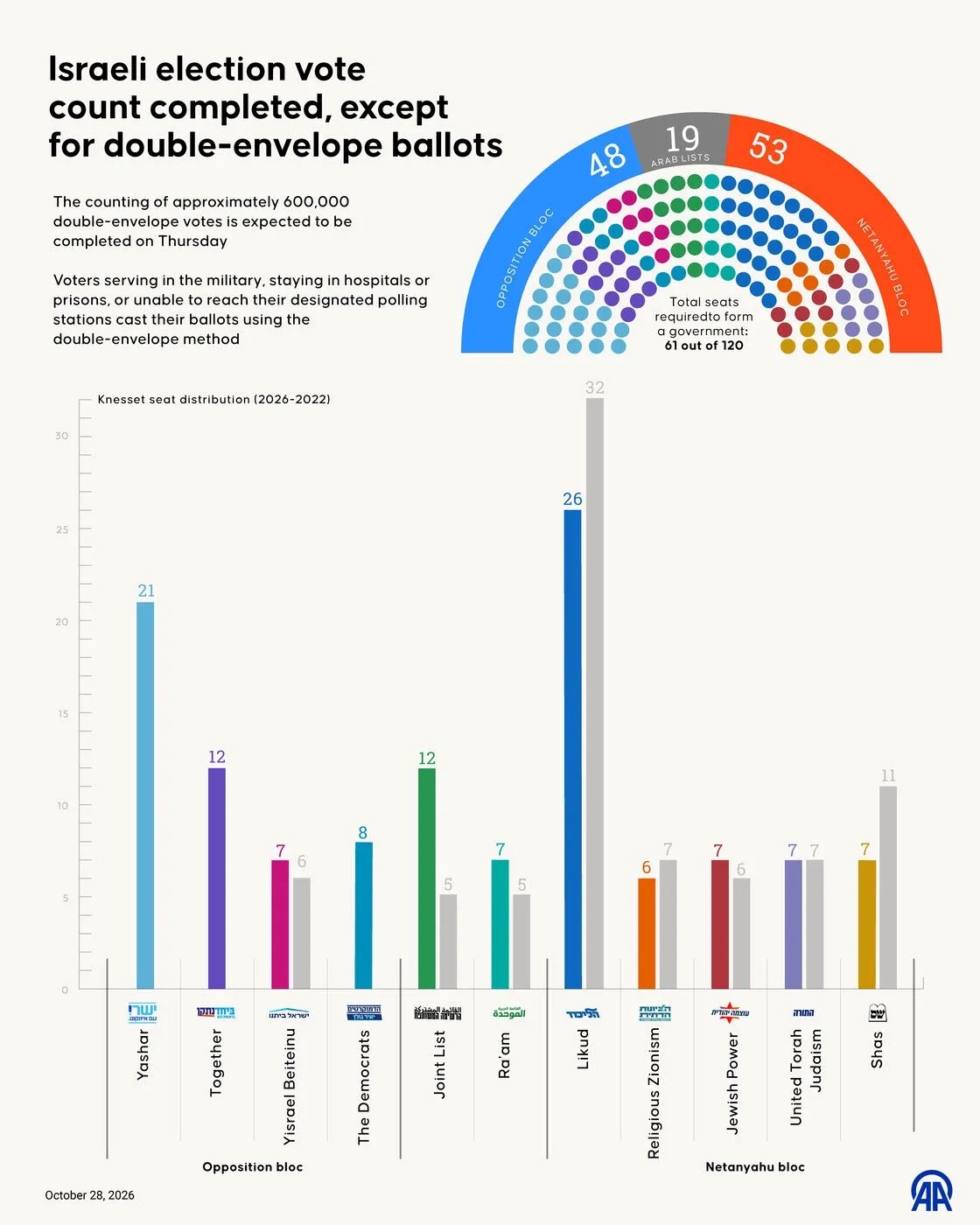
Israeli Prime minister Benjamin Netanyahu hasn’t won. But he hasn’t lost either — at least not yet. Now, he must prevent his rivals from building their own government, and he may survive again. He is likely to remain prime minister of a caretaker government in Israel after receiving unexpectedly strong support from Jewish voters, leaving his opponents little chance of ousting him despite his right-wing bloc failing to secure a majority in the Knesset.
With nearly 86% of the votes counted on Wednesday, Israel’s three main television channels reported that Netanyahu’s bloc, which includes right-wing, far-right, and ultra-Orthodox parties, was on track to win a total of 53 Knesset seats, surpassing the opposition bloc led by his rival Gadi Eisenkot, which was projected to win 48.
Parties representing Arab citizens of Israel and Palestinians within the Green Line were expected to win a record 19 seats, following a high voter turnout.
Netanyahu will remain in office as caretaker prime minister during any coalition negotiations or until new elections are held next year. While the caretaker government faces some limitations, experts point out that it retains its powers, including those related to war with Iran.
In a statement, Chief of Staff Gadi Eisenkot highlighted Israel’s military successes and hinted at the possibility of resuming joint operations against Iran in cooperation with US President Donald Trump, saying the two countries have a “unique historic opportunity” to “eliminate” the Iranian threat “once and for all.”
Eisenkot acknowledged that Netanyahu remains the caretaker prime minister but warned against the possibility of him using security matters for political gain. “I say to the leaders of the security establishment and the civil service: Netanyahu is a caretaker prime minister, lacking a mandate or the confidence of the people,” he said. “Remember that you serve only the state and the interests of the citizens of Israel. Stand firm against any attempt to pressure you. I support you fully and unconditionally. And to Netanyahu, do not you dare to exploit Israel’s security for your own political purposes.”
The outcome highlights the shift to the right among Israeli Jews during the years Netanyahu has dominated the political landscape. The center-left, which dominated Israel for the first half of its history, has dwindled to a small, marginal force.
Almost all Jewish parties now share Netanyahu’s rejection of a future independent Palestinian state, the very idea that has formed the basis of internationally backed peace efforts since the 1990s.
The elections were Israel’s first since its devastating war on the Gaza Strip, which razed the territory to the ground and killed 74,000 Palestinians. The war led to Israel’s international isolation and a significant shift in global public opinion against it, including within its closest ally, the United States.
Netanyahu himself is wanted by the International Criminal Court in The Hague on charges of war crimes. He also faces corruption charges in Israel, which he denies, claiming they are a politically motivated conspiracy against him.
Absentee ballots
With between 430,000 and 480,000 absentee ballots from groups including soldiers, diplomats and hospital patients still uncounted, it could take a day or two for the final election results to emerge.
Once confirmed, President Isaac Herzog will hold consultations with all political factions and invite the leader he believes has the best chance of success to form a government — a process that could take weeks. If they fail to form a government, another election will ultimately have to be held.
In a political career spanning more than three decades, Netanyahu’s political obituary has been written countless times, only for him to prove each time that the eulogy was premature. This week’s Israeli election results appear to give the prime minister’s opponents a chance to end his run, but in Israel’s ruthless political system, nothing is guaranteed.
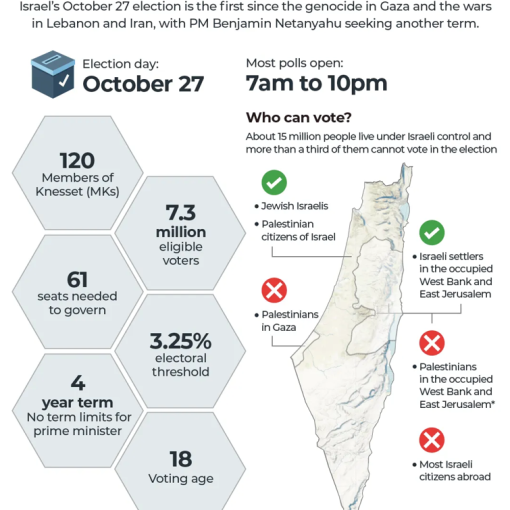
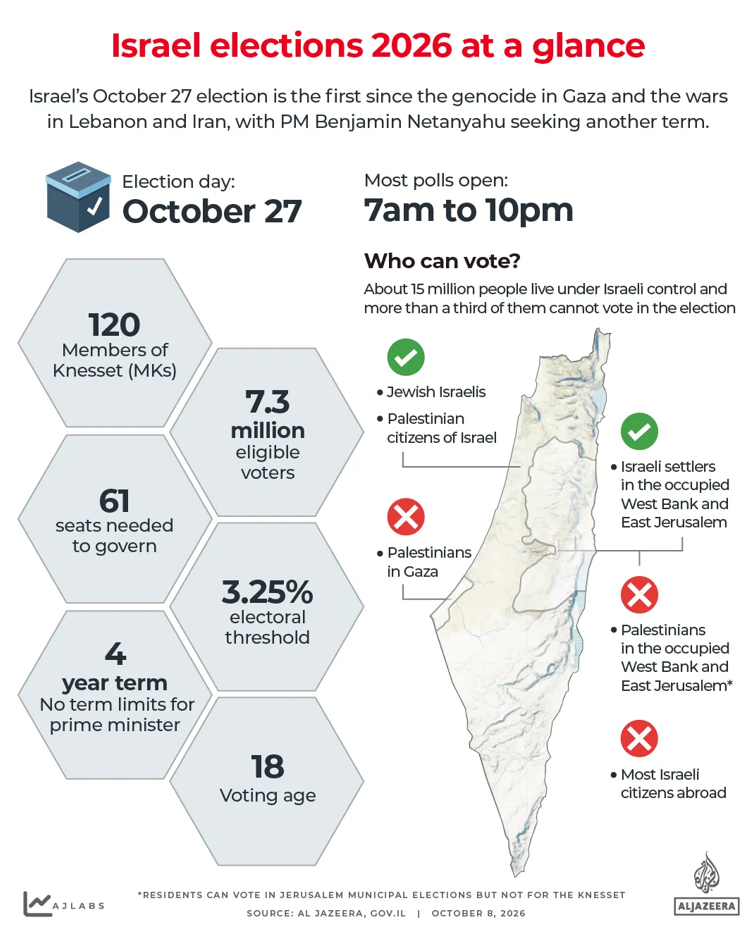
As vote counting nears its conclusion, Netanyahu’s Likud party remains the largest party in the 120-seat parliament, known as the Knesset, with an estimated 26 seats. But his right-wing bloc has lost its majority, expected to win only 53 seats, short of the 61-seat majority needed to govern.
On paper, the opposition holds about 67 seats, but these calculations are fraught with ideological, national and personal rivalries. Netanyahu’s main challenger, Gadi Eisenkot, won 21 seats, but the Jewish opposition parties total only 48, well short of victory. To reach 61, they would need the support of two Arab parties, Ra’am and the Joint List, which are projected to win a record 19 seats between them.
Analysts say the record turnout of Arabs or Palestinian citizens of Israel was partly a backlash to four years of a far-right national security minister under whom violence soared in the Arab community.
Here the calculations become complicated. Ra’am is an Islamist party that draws heavily from Israel’s Bedouin community. Its leader, Mansour Abbas, became the first Arab politician to join an Israeli government after the 2021 election. The Joint List, expected to be the larger Arab party, combines several smaller parties: the Communist Hadash, the secularist Ta’al and the nationalist Balad factions.
On Wednesday, Yair Golan, leader of the left-wing Democrats party, called on his partners to count the Arab parties within the bloc, rejecting what he described as Netanyahu’s “racist division between Jewish and Arab votes.” But two of Eisenkot’s right-wing allies, Naftali Bennett and Avigdor Liberman, have opposed any government that depends on the Arab parties.
The Joint List said Wednesday that it was ready for political cooperation and willing to “do everything in its power to bring Netanyahu’s rule to an end.”
What comes next
The numbers can still change. By Wednesday evening, the Central Elections Committee is expected to finish counting most ballots. Attention now turns to double-envelope ballots from home for soldiers, prisoners, hospital patients and medical staff, diplomats abroad and voters with disabilities. The committee estimates there are between 430,000 and 480,000 double envelopes, enough for more than 10 seats. They are counted separately in a special verification process, with final results expected Thursday.
Then the political maneuvering begins in earnest. The next step runs through President Isaac Herzog, whose post-election role is pivotal. His job here is to consult with all elected parties on the candidate they recommend as prime minister, before choosing the one he believes is most capable of securing a 61-seat majority. This is not necessarily the leader of the largest party but the one with the most plausible path to forming a coalition.
Eisenkot is likely to collect more recommendations than Netanyahu, since the Arab parties are expected to support him.
Then the clock starts ticking. The chosen candidate has 28 days — and a possible 14-day extension — to negotiate with other parties over cabinet posts, budgets and policies in order to form a government. If he fails, the mandate passes to another candidate for another four weeks. If he fails too, the Knesset gets a short window to put forward an alternative candidate. If that fails, the country goes to automatic elections.
Netanyahu, as caretaker prime minister, has a built-in advantage. If Eisenkot receives the mandate first — and fails — all he needs to do is wait for his time to pass. And if Israel finds itself headed for new elections, Netanyahu will remain caretaker for months.
What will Netanyahu do?
A source close to Netanyahu said his main post-election goal is to delegitimize and therefore prevent the Jewish-Arab political cooperation that could send him home. “He is very concerned about a minority government,” the source said. Netanyahu even plans to pressure individual opposition lawmakers not to cooperate with the Arab parties. After campaigning against them throughout the election, Likud issued a statement Wednesday accusing the Arab parties of “stealing the election” through bribery, threats, violence and forgery, echoing election fraud claims. The Central Elections Committee said Wednesday it was examining the complaint, but the committee had already dismissed thousands of complaints from various parties on election day.
Netanyahu plans to “neutralize this possibility by all means,” the source said, “including launching an attack on Iran or enlisting President Trump to intervene in Israeli politics on his behalf.”
The opposition fears that Netanyahu could use a security crisis to stall or block a new government. Before the election, Netanyahu pressed Trump to launch a joint attack on Iran, but Washington held off, partly because Israeli military chief of staff Eyal Zamir warned it could disrupt the vote. An Israeli security source that operational plans are ready and awaiting Trump’s approval, possibly after the US midterms.
An opposition source said: “There is no way to know what Netanyahu will do. We are aware that he may try to push for another escalation.” Another source said Netanyahu “will do everything he can not to leave the prime minister’s office, including stirring domestic and external chaos.”
Eisenkot’s options
Eisenkot isn’t entirely out of options. Even without forming a government, the opposition could still leverage its parliamentary majority to replace the Knesset speaker and other key positions. That could limit Netanyahu’s ability to govern and even enable the opposition to advance legislation.
But Eisenkot, a retired general, isn’t on his preferred battlefield. Netanyahu’s coalition remains incredibly loyal, and he doesn’t have to worry in any real way about defections. The same cannot be said for Eisenkot. His diverse coalition is far less ideologically aligned, and even the smallest step could split the bloc and send the country back to elections.
For now, the focus is on Herzog, whose role has become even more important given the current deadlock. With neither bloc holding a clear majority, he may try to push Netanyahu and Eisenkot to form a unity government.
“We must do everything to avoid another round of elections,” Herzog said Wednesday. He called on party leaders to come to consultations with an “open mind.”
Is Israel heading toward a unity government or another election?
The prospect of a unity government involving Netanyahu and Eisenkot has appeared unlikely, as Eisenkot has refused to serve under Netanyahu, including in a rotation government. Other opposition leaders have also ruled out joining a coalition led by the prime minister.
Eisenkot has called for the leader of the largest party in the opposition bloc to become its candidate for prime minister, though no agreement on the arrangement has been announced within the bloc.
Exit polls also raised the possibility of a minority government that could win a Knesset confidence vote without holding an absolute majority of 61 seats. However, opposition within the bloc to relying on the Arab parties could complicate such an arrangement.
The political deadlock could ultimately lead to another election, although the parties may still reach an agreement through coalition negotiations.
Democrats, Arab parties call to form opposition government
Democrats chairman Yair Golan said the bloc led by Prime Minister Netanyahu lost the 2026 Knesset election, as the opposition bloc reached 65 seats when the Arab parties are included.
“Netanyahu lost. I know how to count to 120. Sixty-five is more than 55. That’s how Israeli democracy works. Period,” he said, calling for the inclusion of Arab parties in the government in the upcoming Knesset elections.
He also said that if Netanyahu is considering forming a Zionist bloc, he should “subtract from his own bloc the 16 Knesset members from the non-Zionist Haredi parties.”
“We have a majority. We have responsibility. And we have an opportunity to form a government of change in partnership with Israel’s Arab citizens. A government that will serve all Israeli citizens,” Golan added.
Joint List chairman Yousef Jabareen said his party was ready to “pave the way for the ousting of Netanyahu’s government. Against a government of bloodshed, against a politics of supremacy, racism and exclusion, we offer a completely different alternative.” He added: “Change comes through Jewish-Arab partnership, a true and equal partnership. No less than that, and no more.”
Later, in an interview with Israel Army Radio, Joint List faction chairman MK Ahmad Tibi (Hadash-Ta’al) hinted at his willingness to sit with the opposition. “The opposition bloc will be able to form a government if it has the courage. We are extending a hand and are ready to help,” he said.
Conclusion
After all votes are counted on Thursday or Friday, the results may change slightly, with Netanyahu’s camp gaining or losing a seat or two, and likewise for Eisenkot’s camp and the Arab lists. But this will not change the following facts:
- Netanyahu’s Likud is the largest party in the Knesset with an average of 26–27 seats.
- The far-right camp led by Netanyahu is the largest bloc in the Knesset with an average of 52–54 seats.
- The anti-Netanyahu opposition camp: Eisenkot’s camp plus the Arab lists enjoy a majority of 65–68 seats, making Eisenkot the more entitled to form a government.
- Netanyahu will not be able to form a government unless he can woo one of the lists in Eisenkot’s camp, and he may seek to split Avigdor Liberman (7 seats) or Naftali Bennett (12 seats) to join his coalition, giving him a majority of 61 out of 120 to form a government. This will be a difficult task because Liberman and Bennett may condition on a rotating premiership and on being the first prime minister before Netanyahu.
- There is a national unity government option bringing together Netanyahu and Eisenkot, which US President Donald Trump is pushing for, having explicitly declared his support for Netanyahu and his need for him to complete the war against Iran. But Eisenkot would lose the credibility and popularity he built on opposing Netanyahu and working to get rid of him.
- Eisenkot’s hesitation and fear of the Zionist right if he relies on the support of the Arab lists makes him unable to form a minority government with Arab cover.
- A likely scenario if no agreement is reached on forming a unity government or neither candidate succeeds in forming a government by securing a 61-seat majority is holding new elections after three or six months. Netanyahu has worked on this and it buys him more time to learn from his mistakes, carry out a military escalation in the region that increases his popularity, and win the next election with a majority that allows him to form a government.