
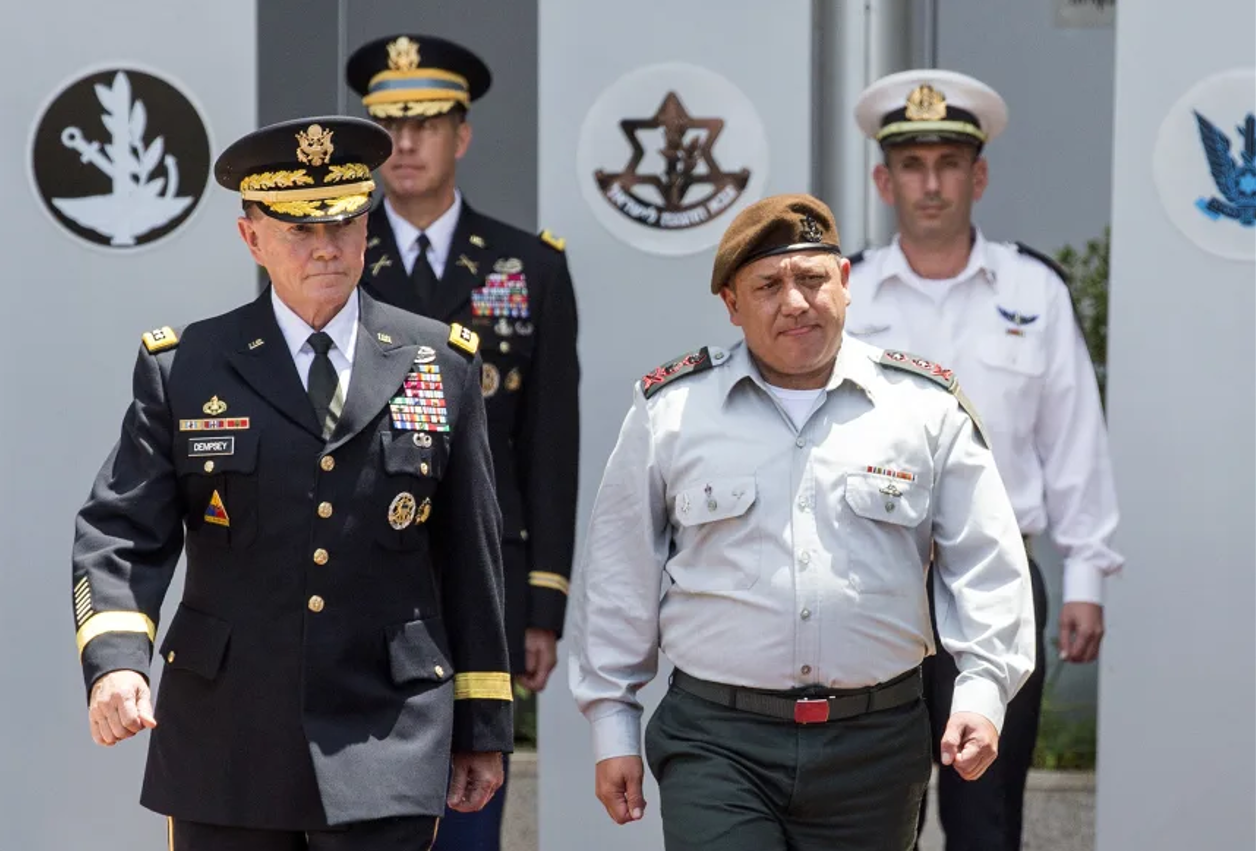
Caption: Eisenkot, right, in his position as Israel’s chief of staff, and US military chief Martin Dempsey take part in a ceremony in Tel Aviv in June 2015.
Israeli President Isaac Herzog gave opposition leader Gadi Eisenkot the first chance to form the next government on Sunday evening.
After the formal announcement, Eisenkot, who ran as Prime Minister Benjamin Netanyahu’s main rival, now has to launch complicated negotiations with potential coalition partners. He has six weeks to form a government.
At the ceremony in Jerusalem, Eisenkot said he wanted a leadership that people can trust, that will act in the interests of the public and that represents all parts of society.
The Oct. 27 election gave neither Netanyahu’s bloc nor Eisenkot a clear majority in parliament. Among the kingmakers — and most politically fraught potential allies — are the Arab-led parties. They made historic gains in the election and have been a target of Netanyahu and his allies.
Eisenkot said Sunday that the conditions for parties joining his governing coalition are support for Israel as a Jewish and democratic state, for its declaration of independence, for military or national service, and recognizing the Hamas militant group as a terrorist organization.
While the announcement doesn’t guarantee that Eisenkot will be the next prime minister, Herzog’s decision is another blow to Netanyahu, who lost his parliamentary majority in the election.
There was no clear winner In Israel, people vote for parties, which form alliances. A coalition needs to have a majority of at least 61 seats in the 120-member assembly, known as the Knesset, to form a government.
Neither Netanyahu nor Eisenkot secured a majority in the election. Netanyahu’s coalition plunged from a peak of 68 seats to just 53. The opposition bloc, led by Eisenkot, won 48 seats, and Arab-led parties secured the other 19.
Eisenkot faces significant challenges
Eisenkot has three options: a power-sharing agreement with Netanyahu, support from Arab-led parties — something several members of his bloc do not support — or an agreement with the ultra-Orthodox parties, which demand military exemptions for their community.
Eisenkot, a former army chief, and his partners made equal military service a central part of their campaign. Specifically, they are seeking an end to the long-standing draft exemptions enjoyed by the ultra-Orthodox.
After Herzog announced Saturday that he would tap Eisenkot, the candidate vowed to form a government as quickly as possible.
But doing so will almost certainly require compromises or broken promises.
Netanyahu has repeatedly claimed the election was “stolen” by Arab parties, which rallied their supporters to vote in large numbers. But he has offered little evidence to support the claims.
Netanyahu is expected to continue his pressure tactics against Eisenkot, saying any alliance with the Arab parties would be an act of betrayal.
Israel’s Shin Bet security agency has launched an investigation into possible foreign interference in the vote, but the country’s Central Elections Commission — and Herzog — say the vote was valid and even if wrongdoing is found, it did not have a significant impact on the result.
Netanyahu called for a “national unity” government with Eisenkot on Saturday night. But it remains unclear whether the two rivals could agree on a power-sharing agreement, and these coalitions are fragile and often collapse.
Eisenkot has the option of forming a coalition with the support of the two Arab-led parties, which won an unprecedented 19 seats in the highest Arab election turnout. Only one Arab party, Ra’am, has ever joined a governing coalition, in 2021. Ra’am has said it will support Eisenkot, but the party does not have enough seats on its own to push Eisenkot into the majority.
Breaking with decades of precedent, the second Arab-led party, the Joint List, said it will support Eisenkot from outside the coalition to end Netanyahu’s grip on power.
That cooperation is fraught for both sides. For the Joint List, it would mean backing a government unlikely to end Israel’s wars or curb settlement expansion in the occupied West Bank. For Eisenkot and other opposition parties, it would mean aligning with parties that not only criticize Israel’s policies but reject its claimed identity as a Jewish state.
One of Eisenkot’s partners, the more conservative Yisrael Beytenu party, already has said it will not join a coalition with Arab-led parties.
Eisenkot also says that any party that joins him must support mandatory military service or civil service. It remains unclear whether the ultra-Orthodox religious parties are prepared to compromise.
These religious parties, which were part of Netanyahu’s outgoing coalition, want to preserve their military exemptions, which they say are needed to preserve their devout lifestyle. But the exemptions have grown especially controversial among the broader public during the past three years of war.
Anticipating its position as a swing vote, the ultra-Orthodox party United Torah Judaism has left the door open to cooperating with Eisenkot.
Eisenkot has 28 days to form a coalition, with a possible two-week extension from the president. If he is unable to form a government, Netanyahu could then be given a chance to put together a coalition. If Netanyahu is also unable to do so, the country will return to elections early next spring.
Who is Gadi Eisenkot?
Gadi Eisenkot, the former Israeli army Chief of Staff and leader of the centrist Yashar party, is the son of Jewish immigrants from Morocco. Eisenkot’s parents, Meir and Esther Eisenkot, immigrated to Israel from Morocco. He grew up in Eilat and Tiberias. If elected prime minister, he would be Israel’s first Mizrahi (Oriental) prime minister.
Eisenkot is a relative newcomer to politics after spending most of his life in the Israeli army.
He enlisted in the Golani Brigade in 1978 and rose over a 40-year career to become chief of staff from 2015 to 2019, serving under Netanyahu.
He entered politics in 2022 alongside another former chief of staff, Benny Gantz. After the October 7, 2023 Hamas-led attack on Israel, the two joined Netanyahu’s emergency war cabinet. But they left in June 2024, pointing to the absence of a clear post-war strategy.
By then, the war had already exacted a heavy toll from Eisenkot’s family. His youngest son, Gal, 25, was killed fighting in Gaza in December 2023, two months into the war. Two of his nephews died in combat as well.
The Differences between Netanyahu and Eisenkot
The current Israeli government led by Benjamin Netanyahu, formed from a right-wing and far-right coalition, is based on a blend of conservative nationalist right-wing ideology, absolute reliance on brute military force to protect national security, and a categorical rejection of the establishment of an independent Palestinian state.
Based on recent political developments and the general elections held on October 27, 2016, a limited divergence in political and domestic visions and conflict management approaches has emerged between the current Prime Minister, Benjamin Netanyahu, and his main rival, former Chief of Staff and leader of the Yeshar (Righteous) party, Gadi Eisenkot.
First: The General Policies of the Current Israeli Government
Netanyahu’s government focuses on strengthening the Jewish identity of the state and supporting settlement expansion in the West Bank.
Judicial Reform Plan: Netanyahu’s government sought to weaken the powers of the Supreme Court and change the mechanisms for selecting judges to strengthen the influence of the executive branch, creating a deep internal division. Netanyahu supports legislation granting the government control over the judiciary to undermine what he calls “judicial dictatorship.”
Eisenkot strongly defends judicial independence and rejects granting the Knesset the power to override Supreme Court rulings.
Military Service: Netanyahu accommodates his ultra-Orthodox (Haredi) allies and maintains their exemption from conscription.
Eisenkot demands mandatory conscription for the Haredim and an expansion of the service to meet the army’s growing needs.
Settlements and the West Bank: Netanyahu supports unrestricted settlement activity and turns a blind eye to illegal outposts to appease the far right in his government. Eisenkot supports large settlement blocs that comply with Israeli law but opposes settler violence and illegal outposts.
The Palestinian Issue and the State: Netanyahu categorically rejects a Palestinian state and has worked strategically to weaken the Palestinian Authority to avoid any political process. Eisenkot also rejects a Palestinian state in the immediate future, but prefers strengthening the Palestinian Authority as an administrative and security alternative against armed factions.
The Future of the Gaza Strip: Netanyahu raises the slogan of “complete victory,” linking withdrawal to the complete disarmament of the Gaza Strip, which implies a long-term military presence. Eisenkot considers Netanyahu’s rhetoric unrealistic; he pledges to end Hamas rule within 18 months by combining military action with international diplomatic arrangements.
The Iranian File: Netanyahu focuses on resounding public promises to topple the Iranian regime and launch direct military strikes. Eisenkot views the idea of regime change through airstrikes as a “delusion,” preferring a more realistic objective: stripping Iran of its enriched uranium and crippling its program through precision operations.
Lebanon: Netanyahu and Eisenkot agree on the necessity of maintaining the Israeli military occupation in South Lebanon and linking any withdrawal to the dismantling of Hezbollah. Both support maintaining a security zone inside Lebanese territory and accept, in principle, partial withdrawals if the Lebanese army takes concrete steps to dismantle Hezbollah’s military infrastructure. Eisenkot had previously expressed support for an eight-kilometer-deep security zone to protect northern Israeli towns from the threat of anti-tank missiles.
Second: Foreign Affairs and Stance Towards Major Powers:
The United States: Israel is its primary strategic ally and relies entirely on it for military and political support. However, the current Netanyahu government tends to publicly display disagreements with Washington when American pressure conflicts with its domestic political calculations. Netanyahu sometimes adopted a publicly confrontational approach with some American presidents, with the exception of Trump; he tends to highlight disagreements with allies in a populist manner if they conflict with his political priorities and domestic popularity, in order to gain favor with the far-right public. Current US President Donald Trump declared his support for Netanyahu before the elections, stating that Netanyahu needs to remain in power to complete the mission against Iran, in a war expected after the US midterm elections next month.
Eisenkot adopts an institutional and restorative approach; he criticizes Netanyahu’s weakening of strategic relations with the United States and calls for making full use of American guarantees.
China and Russia: Israel adopts an economic pragmatism with China especially in infrastructure investments. There is no difference between Netanyahu and Eisenkot regarding relations with Russia and China; both are keen on good relations with both countries.
However, Netanyahu has sparked disagreements with the European Union and Britain over the continued settlement activity in the occupied West Bank and the violence against Palestinians there. Eisenkot is expected to seek to ease tensions with the Europeans, especially Britain and France.
Conclusion
Eisenkot and Netenyahu share a Zionist background and a commitment to using excessive force to protect what they claim is “Israel’s security”. Eisenkot is a hawk who shares many of Netanyahu’s positions. He broadly supported Israeli military operations in Gaza, Lebanon and Iran. Within the Israeli army, he is associated with the “Dahiyeh doctrine” – using overwhelming force against civilian infrastructure to deter claimed future attacks.
However, Netanyahu represents the populist conservative right that relies on media maneuvering to mobilize the public and challenge international and judicial institutions in order to survive politically, while Eisenkot represents the traditional military and institutional class (the security establishment) that demands integrity, administrative clarity, and a return to close diplomatic coordination with Western allies to avoid international isolation.
Thus, The disagreement between the two men is not fundamental regarding Israel’s “existential goals,” but rather a sharp disagreement over leadership style, the legitimacy of institutions, military tactics, and the management of international alliances.