What is the deal?
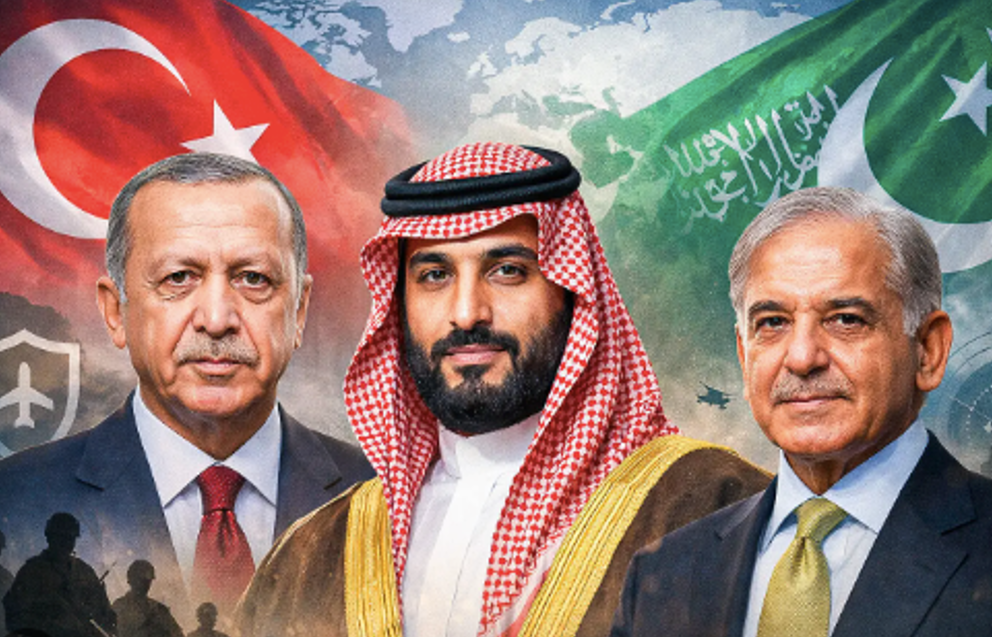
On 7 August 2026, Saudi Arabia, Pakistan, and Turkey signed the Mecca Joint Defence Agreement in the Saudi city of Mecca. The pact states that an armed attack on any one of the three shall be treated as an attack on all. It emerges amid the risk of a renewed Iran war, resumed Houthi strikes from Yemen, and growing Gulf doubts about the reliability of the United States as the region’s primary security provider following repeated Iranian drone and missile attacks.
What does it have for Saudi Arabia, Pakistan, and Turkey?
The agreement is neither a NATO-style alliance nor the foundation of a new regional bloc. Its significance lies elsewhere. For Riyadh, it strengthens leverage against an emboldened Iran while hedging against the limits of U.S. deterrence. By weaving a network of partnerships rather than relying on a single guarantor, Saudi Arabia aims to improve its ability to anticipate and manage shifting threats. Hosting the signing with Turkey also allows Riyadh to present itself as a stabilising force at a moment when Iran and Israel are widely viewed as sources of regional instability.
Saudi Arabia already maintains mutual defence arrangements with Pakistan (since September 2025), and the six Gulf Cooperation Council states (since 2000). None has produced Article 5-style automatic collective responses. Pakistani and Turkish support under the new pact is likely to remain limited and context-specific; Pakistani officials have stressed that the 2025 agreement with Riyadh does not include a nuclear umbrella. Tangible military assistance—such as the troops and air-defence systems Pakistan has already dispatched—will not transform the regional balance. The greater value may be diplomatic: during the earlier phase of the Iran conflict, Riyadh used its closer ties with Islamabad to shape negotiations and manage escalation with Tehran.
The Mecca agreement further signals that Saudi Arabia has largely abandoned the pursuit of a formal U.S. Article 5-style guarantee. It does not, however, amount to a rejection of the American partnership. Instead, it aligns with Washington’s own efforts to shift from primary security guarantor to regional integrator and burden-sharer.
For Pakistan, the pact deepens its embedding in Middle Eastern security architecture, following the 2025 Saudi agreement and growing defence cooperation with Egypt and Jordan. It confers prestige and influence on a nuclear-armed, Muslim-majority state, helping Islamabad project itself as a constructive regional actor rather than a source of repression or terrorism. Strategically, the Middle East remains vital to Pakistan as a source of hydrocarbon imports, a destination for millions of expatriates, and home to key allies. The Trump administration, prioritising burden-sharing among partners, is likely to view favourably an arrangement aimed at collective deterrence against Iran. Pakistan can also invoke the agreement later as evidence of its broader utility should mediation roles change, or the conflict escalate again.
It extends Ankara’s existing security partnerships (e.g., with Qatar, Syria, Libya) by adding Saudi financial/resource power and Pakistan’s nuclear weight. This strengthens deterrence—particularly against perceived threats from Israel—and multiplies Turkey’s strategic options without conflicting with its NATO membership. Turkish firms stand to gain expanded markets, joint production, technology partnerships, and co-production deals (especially drones and advanced systems) backed by Saudi capital. Analysts note Turkey could emerge as the biggest economic beneficiary through higher exports and industrial collaboration.
The pact positions Turkey as a founding actor in an emerging Muslim-world security architecture, reinforces its multi-vector foreign policy, and bolsters its role in energy/trade corridors linking the region to Europe and beyond. It also raises Turkey’s value to Washington as a partner that helps share Middle East security burdens.
How does Iran see it?
Certain quarters in Iran view the Mecca Joint Defence Agreement against the backdrop of the ongoing US-Iran conflict in the Middle East. In the past, the same circles interpreted similar Saudi-led initiatives as efforts to construct a Sunni Muslim alliance directed against Tehran. As a result, Iran has approached these developments with considerable caution. Hardline voices, including parliamentarian Ebrahim Rezaei, have dismissed the pact as a mere “paper agreement” that will not deliver security to Riyadh any more than years of reliance on the United States did, urging Saudi Arabia to reform its policies rather than seek external guarantees. Official Iranian statements, however, have been more measured: Foreign Ministry spokesman Esmaeil Baghaei stated that Tehran sees no reason for concern, citing deep religious, historical and civilisational ties with the three signatories, and portrayed the deal as evidence of a broader regional realisation that security cannot simply be purchased from outside powers. At the same time, the possibility of expanding the coalition to other countries has been noted by some observers as potentially offering an opening for Iran and additional regional states to participate, though Iranian officials have instead emphasised the need for genuine intra-Muslim brotherhood and self-reliance.
What is has for China?
It provides greater space for China as an alternative partner in energy, BRI infrastructure, diplomacy and potentially arms co-production; strengthened Pakistani strategic depth and finances that can channel Chinese technology and influence into the Gulf; improved protection of energy routes and Chinese investments amid diversified regional deterrence; reduced pressure on Beijing by allowing middle powers to absorb some security burdens; and alignment with China’s multipolar narrative through pragmatic, non-ideological arrangements.
Overall, Beijing views the agreement as a manageable regional response to US-Iran tensions and multipolar trends rather than an anti-China development. China is expected to monitor implementation closely, deepen economic and diplomatic ties with the three parties, and favour the pact remaining defensive and non-escalatory. The balance could tilt negative only if the arrangement hardens into an exclusive bloc or crowds out Chinese systems through deeper Western tech integration.